
US Captures Venezuelan President Maduro in Bold Military Strike: Echoes of Imperialism or Justice Served?
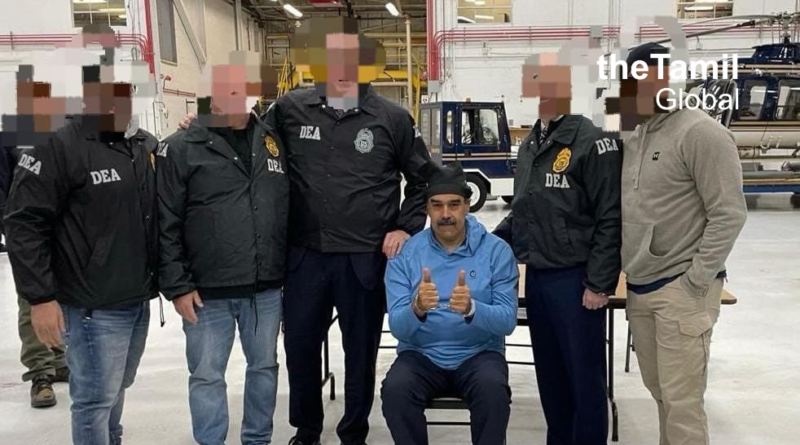
In a stunning escalation of long-simmering tensions, the United States has launched a major military operation in Venezuela, culminating in the capture and withdrawal of President Nicolás Maduro and his wife, Cilia Flores. Announced by President Donald Trump in the early US hours of Saturday morning, the strike marks a dramatic intervention in Latin American affairs, reminiscent of past US actions in the region. As explosions rocked Caracas and military sites across northern Venezuela, the world watches with a mix of alarm and intrigue, questioning the legality and long term implications of this audacious move.
The operation, dubbed “Southern Spear” by US officials, follows months of aggressive posturing by the Trump administration.
Beginning in August 2025, the US initiated a military buildup in the southern Caribbean, deploying warships, including the aircraft carrier USS Gerald R. Ford in November, and approximately 15,000 troops to the region. This was framed as a campaign against alleged drug trafficking networks tied to the Venezuelan government, specifically the Cartel of the Suns, which Washington accuses Maduro of leading.
By September, US forces had begun striking vessels in the Caribbean Sea suspected of drug smuggling, resulting in over 110 deaths. In December, the US imposed a naval quarantine, intercepting and seizing Venezuelan oil tankers, including The Skipper on December 10 and another on December 20.
Covert CIA operations reportedly ramped up in late December, setting the stage for the full scale assault. The strikes themselves unfolded in the pre dawn hours of January 3, 2026, around 2:00 AM local time. Multiple explosions, at least seven, reverberated through Caracas, with low flying aircraft overhead and plumes of smoke rising from key military installations.
Targets included the Generalissimo Francisco de Miranda Air Base (La Carlota), Fort Tiuna, the country’s primary military headquarters, Higuerote Airport, the port of La Guaira, and communication antennas on Cerro El Volcán.
Residents in neighborhoods like Gramoven described intense ground shaking, orange fireballs lighting the sky, and a sense of chaos as people fled their homes. Fires erupted at a military hangar, and power outages hit several facilities, plunging parts of southern Caracas into darkness.
The US Federal Aviation Administration quickly issued a NOTAM prohibiting American aircraft from entering Venezuelan airspace, underscoring the operation’s scale. At the heart of the mission was the elite US Army’s Delta Force, which executed the high stakes capture of Maduro.
Aided by CIA intelligence from an insider within Maduro’s government, stealth drones, and a $50 million bounty on the Venezuelan leader’s head, special forces operatives reportedly stormed Maduro’s location amid the airstrikes.
By 5:21 AM, Trump took to Truth Social to declare victory: “We have captured Maduro and his wife and flown them out of the country.”
He praised the operation as “brilliant” and “truly impressive,” rejecting what he called Maduro’s last minute pleas for negotiation. US Attorney General Pam Bondi swiftly announced fresh indictments against the couple in New York’s Southern District, charging them with narcoterrorism, cocaine importation conspiracy, and possession of machine guns, building on a 2020 indictment.
Bondi vowed they would face “the full wrath of American justice on American soil.” Venezuelan responses were swift and defiant. Vice President Delcy Rodríguez appeared on state television demanding “proof of life” for Maduro and Flores, confirming their disappearance but questioning the US narrative.
Defense Minister Vladimir Padrino López declared a “state of external commotion,” mobilizing military forces nationwide and calling for national unity against “imperialist aggression.”
The government repudiated the strikes as an illegal attempt to seize Venezuela’s vast oil and mineral resources, vowing resistance. Opposition figures, including Maria Corina Machado’s camp, remained notably silent or cautiously supportive, with some sources suggesting Maduro’s exit was negotiated rather than forced.
Archival footage released by Venezuelan state media showed armed forces conducting maneuvers, signaling readiness for further conflict. Internationally, reactions poured in, highlighting a deeply divided global response. Allies of Venezuela, such as Russia, Iran, Cuba, and Belarus, condemned the action as “armed aggression,” “state terrorism,” and a violation of sovereignty, urging an emergency UN Security Council meeting.
Brazilian President Lula da Silva and Mexican President Claudia Sheinbaum echoed these sentiments, decrying it as an affront to the UN Charter. Colombian President Gustavo Petro reported the “bombing” of Caracas and called for multilateral intervention.
On the other side, Argentine President Javier Milei celebrated on social media, while the European Union, through High Representative Kaja Kallas, urged restraint and respect for international law, noting Maduro’s disputed legitimacy from the 2024 election.
Spain offered mediation, and the UK emphasized adherence to international norms without outright condemnation. China advised its citizens to avoid travel, and South Korea prepared evacuation plans. In the US, the operation has sparked domestic debate. Republicans like Vice President JD Vance defended it as lawful, citing Maduro’s indictments and prior “off ramps” offered to him.
However, Democrats such as Senator Ruben Gallego branded it an “illegal war,” and even some Republicans like Senator Mike Lee questioned its constitutionality without congressional approval.
No US casualties were reported, but Venezuelan losses remain unclear, with unconfirmed reports of deaths and injuries from rockets in urban areas. This intervention raises profound questions about US foreign policy under Trump. Is this a justified strike against a “narco state,” or a throwback to the era of gunboat diplomacy? Analysts draw parallels to the 1989 US invasion of Panama, which ousted Manuel Noriega, also on drug charges, but at the cost of hundreds of lives and lingering resentment.
With Maduro in custody, Venezuela faces uncertainty: Will opposition forces fill the vacuum, or will loyalists rally? The UN Security Council is set to convene, but the damage to regional stability may already be done. As a foreign observer, one can’t help but wonder if this “amazing military operation,” as Trump calls it, will usher in peace or perpetuate cycles of intervention.