
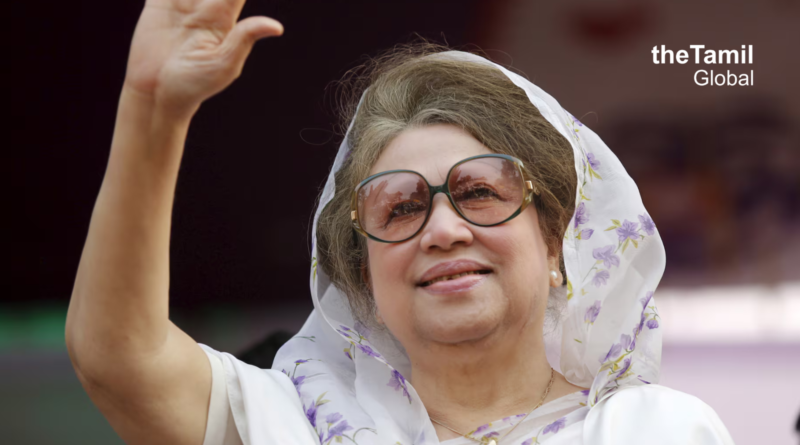
Khaleda Zia, Bangladesh’s First Female Prime Minister, Passes Away at 80
In a poignant end to one of South Asia’s most enduring political sagas, Khaleda Zia, Bangladesh’s first female prime minister and a towering figure in the nation’s democratic struggles, died early this morning, 30th December, at the age of 80. Her passing, announced by the Bangladesh Nationalist Party (BNP) which she chaired for decades, marks the closure of an era defined by fierce rivalries, resilient leadership, and the unyielding pursuit of power in a country perpetually balancing between progress and turmoil. Zia succumbed to a prolonged illness at Evercare Hospital in Dhaka, where she had been receiving treatment, according to statements from her party and family.
Born on August 15, 1945, in Dinajpur, a northern district of what was then British India, Khaleda Zia’s life trajectory was anything but predestined for politics. She grew up in a middle-class family, married Ziaur Rahman in 1960, a military officer who would later become Bangladesh’s president, and initially embraced the role of a homemaker, raising two sons, Tarique and Arafat Rahman. Her entry into the public sphere was thrust upon her by tragedy. In 1981, her husband, President Ziaur Rahman, was assassinated in a military coup, an event that shattered her personal world but ignited her political awakening. “I was a housewife, but circumstances forced me to step forward,” she once reflected in interviews, encapsulating her reluctant yet determined rise.
Zia’s political ascent began in earnest when she joined the BNP, the party founded by her late husband, and quickly rose to its leadership. By 1991, she achieved a historic milestone: becoming Bangladesh’s first female prime minister after leading her party to victory in the general elections that followed the fall of military ruler Hussain Muhammad Ershad. Her tenure, spanning three terms (1991-1996, 2001-2006), was marked by significant economic reforms, infrastructure development, and efforts to liberalize the economy. Under her watch, Bangladesh saw rapid growth in the garment industry, which became the backbone of its export economy, and initiatives to improve education and women’s rights, though critics often pointed to allegations of corruption and nepotism that plagued her administrations.
Yet, Zia’s legacy is inextricably linked to her decades long rivalry with Sheikh Hasina, the daughter of Bangladesh’s founding father, Sheikh Mujibur Rahman, and leader of the Awami League. Dubbed the “Battling Begums” by international media, their feud shaped Bangladesh’s political landscape for over three decades, alternating power between the two women in a cycle of elections, boycotts, and street protests. This antagonism often paralyzed the nation, leading to violent clashes, hartals (general strikes), and economic disruptions. “Their rivalry was more than personal; it was a clash of visions for Bangladesh, one rooted in nationalism and the other in liberation era socialism,” notes political analyst Dr. Ali Riaz in his analyses of the country’s democracy.
Hasina’s ousting in August 2024 amid massive student led protests against her authoritarian rule allowed Zia a brief resurgence. Released from years of house arrest and hospital confinement, Zia was acquitted of graft charges in November 2024, a move seen by many as a corrective to politically motivated prosecutions under Hasina’s regime.
Zia’s health had been deteriorating for years, compounded by ailments including arthritis, diabetes, and heart issues. She spent much of her later life shuttling between hospitals in Dhaka and occasional treatments abroad, including in London and Singapore. Her death comes at a precarious time for Bangladesh, which is still navigating the aftermath of Hasina’s fall. The interim government, led by Nobel laureate Muhammad Yunus, has promised free and fair elections, Zia’s absence will be filled by her son Tarique Rahman, who came back to Bangladesh after 17 years of self exile in London, though questions linger about his ability to unify the party amid internal factions.
In Pakistan, where her husband’s legacy as a war hero in the 1971 Liberation War remains controversial, reactions were respectful. The United States State Department issued a statement praising her as a “pioneer for women in politics,” while the European Union called for peaceful mourning amid fears of unrest. Tributes poured in from across the globe following the announcement. Indian Prime Minister Narendra Modi expressed condolences.
Domestically, BNP supporters gathered outside the hospital, chanting slogans and waving party flags, turning grief into a rally of remembrance. “She was our Deshnetri (leader of the nation), who fought for democracy against all odds,” said one mourner to media, echoing sentiments shared on social media platforms like X, where hashtags such as #KhaledaZia and #IronLadyOfBangladesh trended globally.
Critics, however, remain vocal about Zia’s chequered record. Accusations of fostering crony capitalism, suppressing dissent, and aligning with Islamist groups like Jamaat-e-Islami during her coalitions have tarnished her image among secularists and human rights advocates. The 2004 grenade attack on a Hasina rally, which killed 24 and injured hundreds, was blamed on elements within Zia’s government, though she denied involvement. International observers, including Human Rights Watch, have documented extrajudicial killings and enforced disappearances during her rule, drawing parallels to the abuses under Hasina.
Yet, her supporters argue that such claims were exaggerated by political opponents, pointing to her enduring popularity in rural areas and among the middle class.
As Bangladesh prepares for her state funeral, details of which are yet to be finalized, questions about the future loom large. Will her death unify the opposition or fracture it further? Can the nation move beyond the two-begum dichotomy toward a more inclusive democracy? Zia’s life story, from widow to warrior, embodies the resilience of Bangladeshi politics, but also its deep divisions. In her final years, freed from the shadows of imprisonment, she symbolized hope for many in a post-Hasina era. Now, as the sun sets on her legacy, Bangladesh must chart a path forward without one of its most iconic figures.