
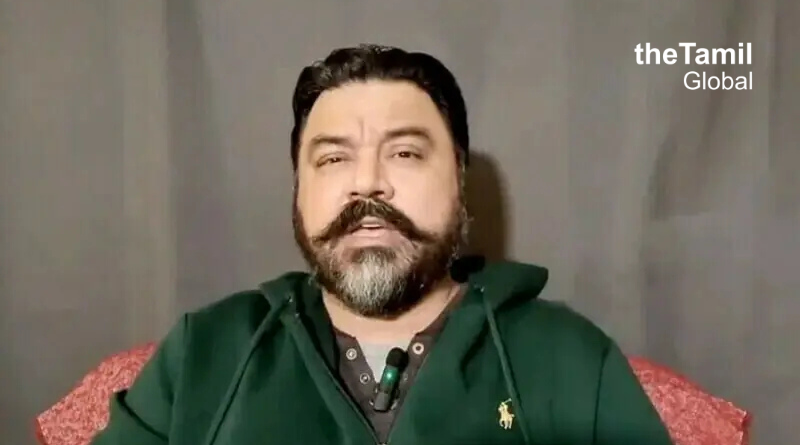
Pakistan Proscribes Retired Lieutenant Colonel-Turned YouTuber Over Pro-Imran Khan Activism
In a move that highlights the deepening rift between Pakistan’s powerful military establishment and supporters of imprisoned former Prime Minister Imran Khan, the federal Interior Ministry has officially listed retired Lieutenant Colonel Adil Farooq Raja, a vocal pro-Khan activist and YouTuber, as a “proscribed person” under the Anti-Terrorism Act, 1997. The designation, announced on December 27, effectively freezes Raja’s assets, restricts his financial transactions, and subjects him to heightened surveillance, marking the latest escalation in the government’s crackdown on perceived threats to national security.
Adil Raja, a former officer of the Pakistan Army’s Sindh Regiment who retired several years ago, has emerged as one of the most prominent overseas critics of the military leadership since Imran Khan’s ouster in April 2022. Operating primarily from the United Kingdom, Raja commands a large following on YouTube and social media platforms, where he regularly accuses senior generals of orchestrating political engineering, human rights abuses, and suppressing dissent. His content, often inflammatory, has included calls for military personnel to refuse unlawful orders and allegations of corruption against top brass. Pakistani authorities claim that Raja’s online campaigns incite mutiny within the ranks and promote anti-state narratives, charges that have now culminated in his formal proscription.
The Interior Ministry’s notification, issued under the Anti-Terrorism Act, describes Raja as a person “involved in terrorism” through his digital activities. Being listed as a proscribed individual means that banks and financial institutions in Pakistan must immediately freeze any accounts linked to him, and no citizen or entity may provide him with financial support. While Raja resides abroad, the measure is largely symbolic in terms of direct enforcement but carries significant political weight, signaling to other overseas dissidents that the state is willing to employ legal tools against critics beyond its borders.
The decision arrives amid a broader pattern of actions against figures associated with Imran Khan’s Pakistan Tehreek-e-Insaf (PTI) party. Since the former premier’s arrest in May 2023 on corruption charges, a case he and his supporters describe as politically motivated, hundreds of PTI workers, lawmakers, and social media influencers have faced detention, trials under military courts, or restrictions. The May 9, 2023, riots following Khan’s initial arrest, which saw attacks on military installations, have been used as justification for an expansive crackdown. Several retired officers who publicly supported Khan have also come under scrutiny, with some facing court-martial proceedings for alleged incitement.
Human rights organizations and opposition voices have condemned the proscription as an attempt to silence dissent. “Labeling a retired officer who exercises his right to free speech as a terrorist sets a dangerous precedent,” said a spokesperson for Human Rights Watch in a statement. PTI leaders, including senior vice president Sher Afzal Marwat, called the move “fascist” and evidence of the military’s unwillingness to tolerate criticism. From his prison cell in Rawalpindi, Imran Khan has repeatedly alleged that the current civilian-military hybrid setup is determined to dismantle his party ahead of any future elections.
Government officials defend the action as necessary for national security. A senior Interior Ministry source, speaking on condition of anonymity, told reporters that Raja’s content had crossed the line from political criticism into actively encouraging disobedience within the armed forces, a red line for an institution that prides itself on discipline and apolitical stature. The military’s Inter Services Public Relations (ISPR) directorate has not issued a direct comment on Raja’s case, but recent statements have emphasized zero tolerance for campaigns that “target the integrity of the armed forces.”
Raja himself reacted defiantly on social media shortly after the notification surfaced, posting a video in which he mocked the decision and vowed to continue his activism. “They can freeze accounts I don’t have in Pakistan, but they cannot freeze the truth,” he declared. Supporters quickly mobilized online, trending hashtags in solidarity and accusing the government of authoritarian overreach. Meanwhile, PTI’s diaspora network, particularly strong in the UK and North America, has promised legal challenges and increased fundraising to support proscribed individuals.
The proscription of a former military officer turned digital dissident reflects deeper tensions within Pakistan’s civil-military equation. Historically, retired officers have enjoyed considerable latitude to engage in politics or media, but the post-2022 environment appears markedly different. Analysts note that the military, under Army Chief Field Marshal Asim Munir, has adopted a harder line against any perceived internal threats, especially those amplified through social media. With Pakistan grappling with economic crises, political instability, and rising militancy in border regions, the leadership seems intent on consolidating narrative control.
International observers are watching closely. Western governments, which maintain security partnerships with Islamabad while advocating for democratic norms, have expressed concern over shrinking space for free expression. The European Union and United Kingdom have previously raised cases of overseas Pakistanis facing transnational repression, including surveillance and threats. Whether Raja’s proscription prompts diplomatic commentary remains to be seen, but it adds another layer to Pakistan’s complex image abroad, one of a nuclear-armed nation striving for stability while wrestling with internal divisions.
As 2025 draws to a close, the case of Adil Raja serves as a stark reminder of the high stakes in Pakistan’s polarized political arena. For the government and military, it is a necessary measure to safeguard institutions. For Khan’s supporters, it is further proof of an orchestrated campaign to erase their movement. Whatever the perspective, the proscription ensures that the confrontation between Pakistan’s most popular political figure and its most powerful institution will continue to play out, both at home and across digital frontiers.