
Millions Gather in Bangladesh to Bid Farewell to Murdered Student Leader Osman Hadi
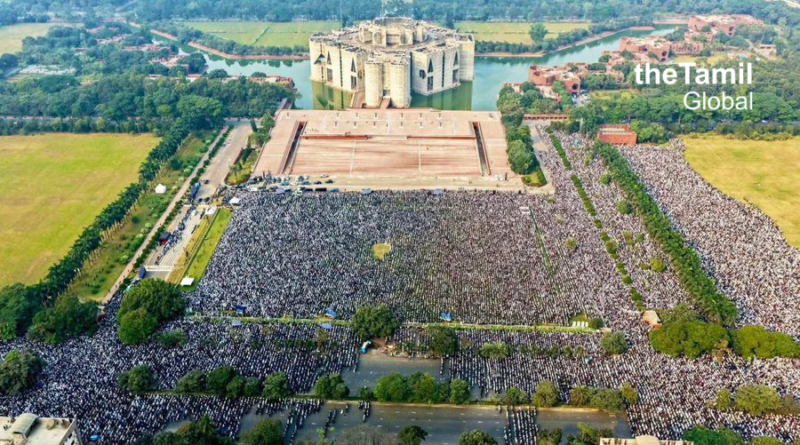
In an extraordinary outpouring of grief and solidarity, millions of Bangladeshis converged on the capital Dhaka, yesterday to attend the state funeral of Sharif Osman Hadi, the 32 year old student leader whose brazen assassination has cast a long shadow over the country’s fragile democratic transition.
Known affectionately as Osman Hadi, the charismatic spokesperson for the Inqilab Mancha platform rose to national prominence during the 2024 student led uprising that dramatically ousted longtime pro-Indian Prime Minister Sheikh Hasina after 15 years in power. His fearless advocacy for reform and justice made him a symbol of the youth-driven revolution, and he was preparing to contest the upcoming February 2026 parliamentary elections as an independent candidate in Dhaka 8.
Tragedy struck on December 12 when two masked gunmen on a motorcycle shot Hadi in the head as he traveled in an auto rickshaw near a mosque in Dhaka’s Paltan area. Critically wounded, he was first treated locally before being airlifted to Singapore General Hospital. Despite intensive care, he succumbed to his injuries on December 18, plunging the nation into mourning and fury.
His death ignited two days of violent protests, with crowds vandalizing pro-India media offices, including those of Prothom Alo and The Daily Star, where one building was set alight and journalists had to be rescued, and chanting anti-India slogans. Many protesters accused elements linked to Hasina’s supporters, now in exile in India, of orchestrating the killing, though New Delhi has strongly denied any involvement. The unrest also saw attacks on cultural sites and diplomatic tensions flare anew.
Yesterday’s funeral, held under unprecedented security at the South Plaza of the National Parliament Building on Manik Mia Avenue, transformed into a sea of mourners. Interim Chief Adviser and Nobel laureate Muhammad Yunus attended, joined by advisory council members, Army Chief General Waker-uz-Zaman, and leaders from various political groups, including the Bangladesh Nationalist Party and Jamaat-e-Islami affiliates.
In an emotional address, Yunus described Hadi as a “voice of conviction and commitment” whose sacrifices would inspire generations. “He will remain in the heart of all Bangladeshis as long as the country exists,” he said, emphasizing unity amid grief. Mourners waved Bangladeshi flags, chanted slogans like “We will not let Hadi’s blood go in vain,” and carried portraits of the fallen leader.
The government declared December 20 a national day of mourning, with flags flown at half-mast across the country and abroad. In a honor symbolizing his revolutionary legacy, Hadi was buried beside the mausoleum of national poet Kazi Nazrul Islam at the central mosque on Dhaka University campus, a site revered as the cradle of Bangladesh’s independence movements.
Eyewitnesses described scenes of profound emotion: families traveling from distant districts, students weeping openly, and ordinary citizens lining the procession route. “He died for our future,” said one mourner, a government employee who journeyed overnight to attend. Rights groups, including Amnesty International, called for swift, impartial investigations into the assassination and subsequent violence.
As Bangladesh navigates this turbulent chapter, Hadi’s killing underscores the threat faced by other nations in South Asia, from India. With elections looming, fears persist that political assassinations could derail the hard fought gains of the 2024 uprising. Yet yesterday’s massive turnout also signaled the enduring power of the youth movement that reshaped the nation, a poignant reminder that Hadi’s ideals live on in the hearts of millions.