
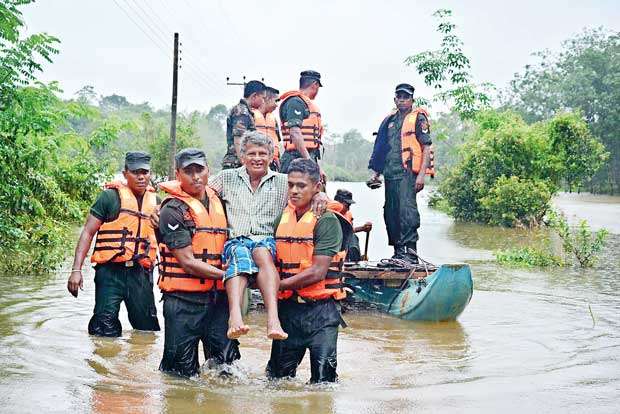
Over 171,000 Sri Lankans from 51,000 families have been internally displaced by Cyclone Ditwah.
The catastrophic trail left by Cyclone Ditwah, which swept across Sri Lanka last week, has plunged the island nation into a severe humanitarian crisis, shattering communities and laying bare the structural fragility of a country still reeling from its 2022 economic collapse. The disaster, which brought torrential rain and wind across all 25 districts, triggered the country’s worst floods and landslides in two decades. While the official focus remains on the rising death toll, confirmed at 474 fatalities and 356 people missing according to the latest figures from the Disaster Management Center (DMC), the sheer scale of internal displacement has created a silent, growing emergency demanding immediate international attention.
The most visible sign of the tragedy is the emergence of a nation living in makeshift shelters. Updated government figures compiled by the DMC show that at least 201,875 individuals from over 53,000 families have been forced out of their homes, now sheltering in 1,385 government-run safety centers established primarily in schools and temples. This vast, displaced population, which includes over 275,000 children, as estimated by UNICEF, faces an immediate fight against disease, hunger, and uncertainty. The Western, North-Western, and Northern districts, including Colombo, Gampaha, and Puttalam, recorded the highest numbers of affected people due to widespread inundation from overflowing rivers like the Kelani. However, the worst of the human suffering, and the most acute access challenges, are concentrated in the central hill country districts of Kandy, Nuwara Eliya, and Badulla, where deadly landslides have buried entire villages.
For those inhabiting these temporary shelters, the crisis extends far beyond the lack of a roof. The International Organization for Migration, which is mobilizing its response to support the over 209,000 displaced individuals it recorded earlier in the week, warned that families are “sheltering in overcrowded, temporary spaces while facing immense uncertainty.” Kristin Parco, IOM Chief of Mission in Sri Lanka, noted that the country has “not seen such widespread destruction in years,” emphasizing the critical need for non-food items, shelter, and basic services to ensure the safety and dignity of the uprooted. The immediate health risks are multiplying, with the World Health Organization warning of the heightened danger of water-borne diseases due to damaged water treatment and supply infrastructure. Furthermore, as much of the national focus has been on the disaster response, the core vulnerabilities of the island’s population, already battered by the economic crisis, have been severely exacerbated. The long-term recovery will be compounded by the estimated damage to over 41,329 houses, many of which are completely destroyed, according to the DMC.
The government has formally declared 22 of the island’s 25 districts as national disaster-affected areas, invoking emergency laws to expedite administrative and recovery processes. The Ministry of Finance has issued circulars to facilitate rapid spending for relief and has raised the assistance allowance for flood-affected households to LKR 25,000, up from the initial LKR 10,000, to help with home cleaning and sanitation restoration. Simultaneously, international partners are coordinating efforts, with the United Nations and humanitarian partners activating a joint response plan and commencing a Joint Rapid Needs Assessment (JRNA) with the Disaster Management Center to identify the most critical gaps. Despite these efforts, relief operations continue to be hampered by access challenges, with over 200 landslides blocking major access roads, leaving some remote areas completely cut off. The long process of rebuilding, both physically and psychologically, for the hundreds of thousands now living in camps has just begun, raising serious questions about the nation’s climate resilience and its preparedness for future extreme weather events.