
The Bear Hug and the Balancing Act: Putin’s Visit Puts New Delhi’s Geopolitical Tightrope to the Test
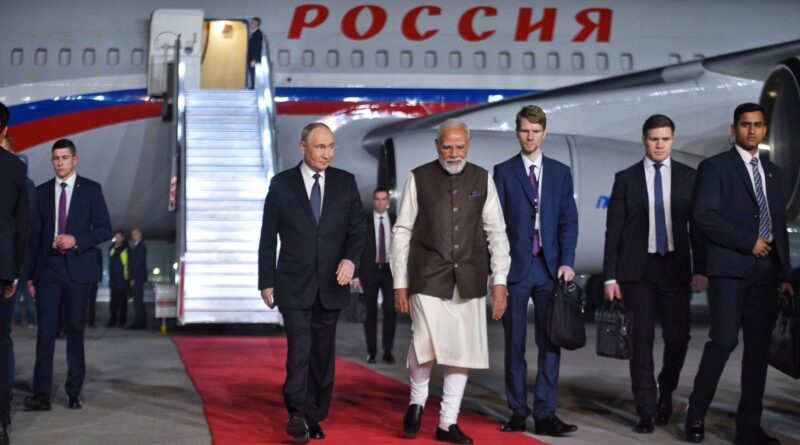
Russian President Vladimir Putin’s arrival in the Indian capital on Thursday for a two-day state visit, his first to the country since the full scale Russia-Ukraine war in 2022, has been met with a choreographed mix of grand diplomatic pageantry and quiet global scrutiny. The visit, marking the 23rd India-Russia Annual Summit and coinciding with the 25th anniversary of their strategic partnership, underscores New Delhi’s enduring commitment to its time-tested friendship with Moscow, even as the West continues its push for Russia’s international isolation. Prime Minister Narendra Modi broke with standard protocol to personally greet his “friend,” President Putin, at the airport, setting a warm and highly symbolic tone for the critical discussions that followed. The bonhomie on display was deliberate, designed to project the “Special and Privileged Strategic Partnership” that has defined India-Russia ties for decades.
The primary focus of the talks, according to official statements from the Ministry of External Affairs (MEA), was a comprehensive review of bilateral relations and a mutual commitment to setting the vision for the next phase of cooperation. Crucially, the visit provided an opportunity for the leaders to “exchange views on regional and global issues of mutual interest,” a diplomatic phrasing that includes the ongoing conflict in Ukraine, the status of Afghanistan, and the increasingly complex dynamics of the Indo-Pacific region. These discussions are taking place against a backdrop of intense global diplomatic pressure, with European envoys having reportedly urged the Indian government to use its unique relationship to lean on President Putin to halt the war, media reports have indicated. India’s established position, reiterated by its officials, is that “solutions can’t be found on the battlefield” and that all parties must constructively seek an early cessation of the conflict.
The commercial agenda, however, remains the cornerstone of the visit. Highlighting Moscow’s urgent need to diversify its economic partnerships amidst Western sanctions, President Putin arrived with a large delegation of Russian business leaders. Government sources in New Delhi confirmed to local media that a major objective of the Indian side is to address the burgeoning trade deficit with Russia by exploring new avenues for Indian exports. Multiple agreements and Memoranda of Understanding (MoUs) are anticipated in key sectors like shipping, healthcare, fertilisers, and connectivity. Indian government officials, quoted in the press, emphasized that the visit is expected to significantly boost economic co-operation, with efforts underway to expand Indian exports, especially pharmaceuticals, automobiles, agricultural products, and marine products, to the Russian market. The shared goal, previously articulated by Russian Finance Minister Anton Siluanov, is to reach a bilateral trade turnover of $100 billion by 2030, a figure that is now dependent on finding robust mechanisms for financial settlements outside the Western system.
Defence cooperation, the historical bedrock of the relationship, also featured prominently. Since the signing of the Military-Technical Cooperation agreement for 2021–2031 on December 6, 2021, the focus has expanded from a buyer-seller relationship to include joint research, development, and production. The sale of additional S-400 long-range anti-aircraft missile systems was reportedly high on the agenda. This defense nexus, which accounts for a substantial percentage of India’s military hardware, places New Delhi in a delicate position with its Western partners, particularly the United States, which has sought to penalize nations trading with sanctioned Russian entities. India’s strategic autonomy remains its guiding principle, a point of view the leaders were set to affirm during their closed-door summit at Hyderabad House. The visit culminates with a ceremonial reception, a wreath-laying at Rajghat, and a state banquet hosted by President Droupadi Murmu, ensuring the diplomatic optics reinforce the message that the ‘Special and Privileged Strategic Partnership’ is not merely surviving, but actively seeking to expand, in a fractured global order. The comprehensive array of agreements expected to be signed across trade, energy, and defense will ultimately serve as the concrete measure of this summit’s success.