
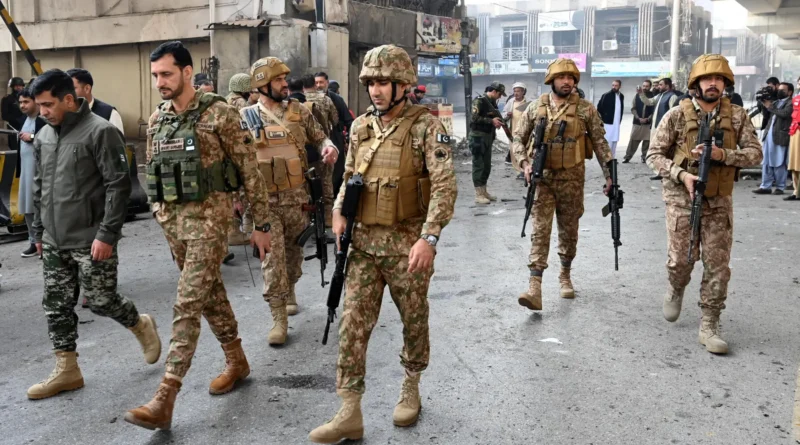
A suicide attack on the headquarters of Pakistan’s Federal Constabulary force in Peshawar has killed six including three paramilitary personnel.
A highly coordinated suicide and gun attack ripped through a key federal security installation in Peshawar, the capital of Pakistan’s restive Khyber Pakhtunkhwa province, leaving at least six people dead and spotlighting the country’s escalating battle against renewed militant violence. The assault, which targeted the heavily guarded headquarters of the Federal Constabulary (FC), a paramilitary force responsible for internal security and counter-insurgency operations, involved three militants and tragically claimed the lives of three security personnel.
The incident unfolded in the early hours of Monday morning, striking the FC complex situated in the city’s dense Sadar area, not far from a major military cantonment. According to reports from the site and official police sources, the attack began when one suicide bomber detonated a vest packed with explosives at the facility’s main gate. This initial blast killed the FC officers on duty there. Two other militants, armed with firearms and also carrying explosive devices, attempted to storm the compound but were intercepted. Peshawar Capital City Police Officer (CCPO) Mian Saeed Ahmad confirmed the sequence of events to the press, stating that the prompt action by the remaining FC personnel was instrumental in averting a catastrophe. “One bomber blew himself up on the gate, while two others tried to enter the premises but were gunned down by FC personnel,” CCPO Ahmad was quoted as saying in local media, including the Dawn newspaper. He further emphasized that the terrorists’ inability to reach the parade area, where approximately 150 security personnel were gathered for morning drills, prevented what he termed a “much larger tragedy.” The three attackers were killed, one by detonation, and two by return fire. Six civilians in the immediate vicinity were also injured and shifted to the Lady Reading Hospital, though hospital spokespersons have later confirmed to the media that their injuries were stable.
While no militant group immediately claimed responsibility, the attack fits the operational profile of the Tehrik-e-Taliban Pakistan (TTP), the Pakistani Taliban, which has intensified its campaign against security forces since the Afghan Taliban took control of Kabul in 2021. The FC, formerly the Frontier Constabulary, has been a perennial target. Its role has historically involved policing the border between Khyber Pakhtunkhwa’s settled areas and the formerly semi-autonomous tribal regions, a function that has since broadened to include the security of vital installations and internal security duties across the nation, making it a key pillar of the state’s counter-terrorism grid. Its headquarters, located in Peshawar Cantt, is a symbolic target for groups seeking to challenge the state’s writ. The government had only recently announced plans, in September 2025, to shift the FC headquarters from the volatile region of Peshawar to the capital, Islamabad, in an effort to modernize the force and improve federal coordination, a move that highlights the perceived vulnerability of its current location.
The high-profile security breach drew immediate and unified condemnation from Pakistan’s top leadership. Prime Minister Shehbaz Sharif used an official statement to strongly condemn the “cowardly” act and offered praise for the bravery of the officers who were martyred in the line of duty. “We will thwart the evil designs of terrorists who attack Pakistan’s sovereignty and integrity,” the Prime Minister asserted, reiterating the government’s resolve to continue counter-terrorism operations. President Asif Ali Zardari also condemned the assault, offering “heartfelt condolences” and issuing a resolute message via social media, stating that “externally backed Fitna-al-Khawarij cannot weaken Pakistan’s unity, resilience or resolve,” thereby pointing toward foreign sponsorship for the militants. The Interior Minister, Mohsin Naqvi, echoed these sentiments in a statement reported by Dawn, saying the sacrifices of the fallen personnel will not be forgotten.
The Peshawar attack, however, is not an isolated incident; it serves as a stark metric of the rising tide of violence. Data compiled by the Islamabad-based independent think tank Center for Research and Security Studies (CRSS) indicates a grim trend. According to a recent CRSS report, the province has witnessed a significant uptick in terrorist incidents, with security personnel and civilians frequently becoming victims. The report highlights that this prolonged insecurity has an undeniable humanitarian impact, leading to the diversion of resources. Beyond the immediate threat to life, groups like the TTP have systematically targeted social infrastructure. Data collected by local Non-Governmental Organizations (NGOs) specializing in education reform in the region indicates that over 450 schools in Khyber Pakhtunkhwa have been destroyed over the last decade by militants aiming to disrupt literacy and particularly girls’ education, forcing students into makeshift or ruined buildings. This sustained campaign of violence not only costs lives but actively undermines the future development prospects of the province. Authorities have sealed off the area and launched a massive search and clearance operation across the city, aiming to trace the domestic facilitators of the three slain attackers and prevent any further imminent threats. The persistent cycle of violence, coupled with the fragile political landscape and strained relations with the Afghan Taliban, ensures that Pakistan remains deeply entrenched in a difficult and ongoing security crisis