
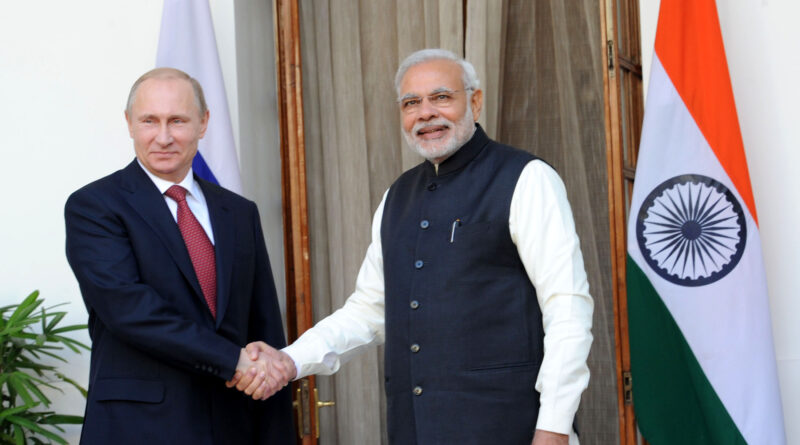
Russian President Vladimir Putin to Land in India on December 4th for a Two Day State Visit.
In a display of enduring geopolitical defiance, Russian President Vladimir Putin is scheduled to land in New Delhi on December 4th for a two-day State visit, marking the 23rd India-Russia Annual Summit with Prime Minister Narendra Modi. This visit, confirmed by an official statement from India’s Ministry of External Affairs on Friday, is more than a routine exchange; it is a critical measure of the ‘Special and Privileged Strategic Partnership’ between the two nations, which has been severely tested by the continuing war in Ukraine and the resulting Western sanctions. The agenda is heavy, balanced precariously between massive, multi-billion dollar arms deals and the delicate diplomacy required to sustain New Delhi’s unique position as a strategic partner to both Moscow and Western powers.
Indian MEA statement emphasized that the visit would be an opportunity for the leadership to “review progress in bilateral relations, set the vision for strengthening the ‘Special and Privileged Strategic Partnership’ and exchange views on regional and global issues of mutual interest.” The core of these discussions, however, is military technology. Defence cooperation is historically the strongest pillar of the relationship, and this summit aims to address long-standing supply chain disruptions exacerbated by the Ukraine conflict. Indian Defence Secretary Rajesh Kumar Singh confirmed to local media outlets that the focus is on expediting delayed contracts and broader institutional cooperation. The most crucial item on the table is the procurement and maintenance of advanced air defence systems.
New Delhi is expected to push for an additional five regiments of the S-400 Triumf air defence system, a platform that has been deemed a “gamechanger” by the Indian Air Force after its “successful” operational deployment. According to top sources quoted in the Indian press, India also seeks a comprehensive maintenance, repair, and overhaul (MRO) facility to be set up in the country for the existing systems, ensuring long-term operational readiness. The discussions will also include potential future acquisitions, such as the Russian fifth-generation Sukhoi-57 fighter jet and the next-generation S-500 anti-ballistic missile system. These massive arms purchases, essential to India’s defense strategy against its northern borders, underscore why the country has consistently resisted Western pressure to decouple from Moscow.
Yet, the geopolitical tightrope walk is evident. This will be President Putin’s first trip to India since the war began in 2022, an absence that speaks volumes about the diplomatic sensitivities involved. India has maintained a principled stance of “strict neutrality,” refraining from condemning Russia’s actions at the United Nations while continuously advocating for an “early cessation of the conflict and the establishment of an enduring peace,” a position reiterated by External Affairs Minister S Jaishankar following his pre-summit talks in Moscow. The Russian visit occurs against the backdrop of increased trade tensions with Washington, particularly the 50 per cent tariff recently imposed by the United States on certain Indian exports, a move widely viewed as a penalty for India’s continued purchase of discounted Russian oil.
Beyond arms, energy cooperation remains a central, and controversial, topic. India has become a crucial market for Russian crude oil, with imports skyrocketing to nearly US$50 billion in the 2024-2025 fiscal year, a surge that has provided Moscow with a vital revenue stream amid Western sanctions. According to an analysis published by the Observer Research Foundation (ORF), a leading Indian think tank, this oil connection has “seemingly benefited all stakeholders,” with a significant portion even being re-exported to the West as refined products, though the organization notes that structural challenges prevent a broader economic partnership. The trade imbalance, coupled with complex payment issues involving national currencies, will be a priority for the two leaders to resolve. The ORF also points out that while the government-level interaction remains robust, Indian businesses remain hesitant to deepen ties with Russia due to global market exposure. The outcome of the 23rd Annual Summit will not just determine the future trajectory of the decades-old India-Russia partnership; it will define the limits of Indian foreign policy autonomy in a rapidly fragmenting and increasingly bipolar world. All eyes are now on New Delhi, watching to see how the democratic giant navigates this high-stakes diplomatic maneuver.