
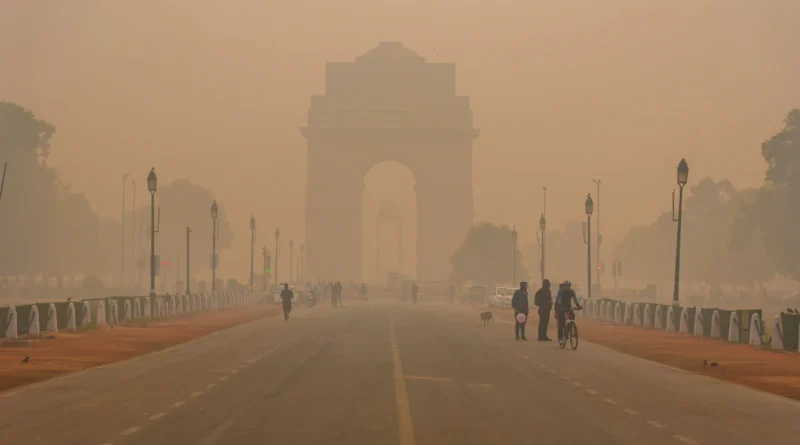
India’s capital, New Delhi, instructs workers to work from home as air quality remains at the world’s most polluted levels.
New Delhi, a city famed for its historical grandeur and political gravity, has once again retreated behind a veil of toxic, grey smog, forcing the government to issue an unprecedented and mandatory work-from-home directive that lays bare the capital’s annual public health crisis. As the winter inversion layers trap lethal particulate matter, the atmosphere itself has become an emergency, driving millions indoors and spotlighting the systemic failure to protect the air citizens breathe. In a move that highlights the severity of the crisis, the Delhi government’s Department of Environment & Forests has mandated that all government offices and private establishments operating within the National Capital Territory (NCT) must function with no more than 50% of staff physically present, with the remaining workforce compelled to work remotely. This decision, issued under Stage III of the Graded Response Action Plan (GRAP), marks one of the most drastic official actions taken to curb vehicular emissions, which are a major component of the city’s winter pollution load.
The order was triggered by consistently hazardous air quality readings across the metropolis. Data from the Central Pollution Control Board (CPCB), the national government’s environmental monitoring body, showed the city’s average Air Quality Index hovering in the ‘very poor’ to ‘severe’ categories for over ten consecutive days, with numerous monitoring stations breaching the 400 mark. The CPCB classifies an AQI between 401 and 500 as ‘severe,’ meaning the air can affect healthy people and seriously impact those with existing diseases. On Monday, several key areas, including Anand Vihar and Bawana, recorded AQI readings well above 430. The severity of the situation has been compounded by a recent directive from the Commission for Air Quality Management, the central agency overseeing pollution control in the NCR, which formally revised the GRAP schedule. This revision proactively moved measures, such as the 50% work from home rule, from the ‘Severe +’ Stage IV to the lower ‘Severe’ Stage III, illustrating the government’s belated recognition of the need for tougher, earlier intervention.
The work from home mandate is fundamentally an attempt to throttle the lifeblood of Delhi’s traffic. According to the Decision Support System (DSS) of the Indian Institute of Tropical Meteorology, Pune, vehicular emissions contributed over 21.6 per cent to Delhi’s pollution on Monday, making it the largest single source contributor among the locally generated pollutants. The government is banking on the vast reduction in daily commute trips to provide immediate, if temporary, relief from the suffocating conditions. However, the efficacy of this measure is a topic of intense debate among experts and activists alike. A working paper from the New Delhi based think tank, the Centre for Policy Research (CPR), titled “Work from Home – How Good is it for the Environment?” highlighted years ago that while the reduction in transport related energy demand is promising, especially since transportation accounts for roughly 25% of PM2.5 emissions in Delhi during winter, the overall environmental benefits are “ambiguous.” The report cautions that widespread work from home adoption can shift energy consumption and emissions from the workplace to residential areas, potentially increasing the use of less regulated forms of power and heating.
Beyond the complex environmental calculations, the human cost is undeniable. For residents, the decree is a stark reminder of the chronic health hazard they face annually. The health risks are being passionately championed by NGOs like Warrior Moms, a nationwide movement of mothers advocating for clean air. The group and others have repeatedly stressed the long term impact on the most vulnerable, particularly children, whose schools were previously closed or shifted to online learning when the pollution reached its peak. While the mandate provides a safe haven for many, it also exposes the profound socio-economic gap that characterizes the city. The policy primarily benefits the professional, white collar workforce with access to broadband and climate controlled homes. Essential service workers, construction labourers, street vendors, and millions of others whose livelihoods depend on physical presence outdoors remain acutely exposed to the hazardous air. Even among those capable of remote work, stories of corporate insensitivity have circulated widely online. One viral post shared by an employee, since corroborated by several news outlets, detailed a manager denying a work from home request, even amidst reports of personal health issues, with the dismissive justification that “everyone is suffering from pollution.”
As the capital chokes, the mandatory stay at home order serves as both an emergency stopgap and a damning indictment. It prevents citizens from accessing one of the most basic human rights, the right to breathe clean air, forcing a digital, indoor existence until the weather patterns shift. The global media spotlight returns to Delhi year after year, yet the core issues of stubble burning in neighbouring states, industrial emissions, and an exploding vehicle population remain only partially addressed. The work from home decree is a necessary defensive retreat, but it is not a victory; it is merely a measure to mitigate the consequences of a siege that the state has yet to permanently lift.