
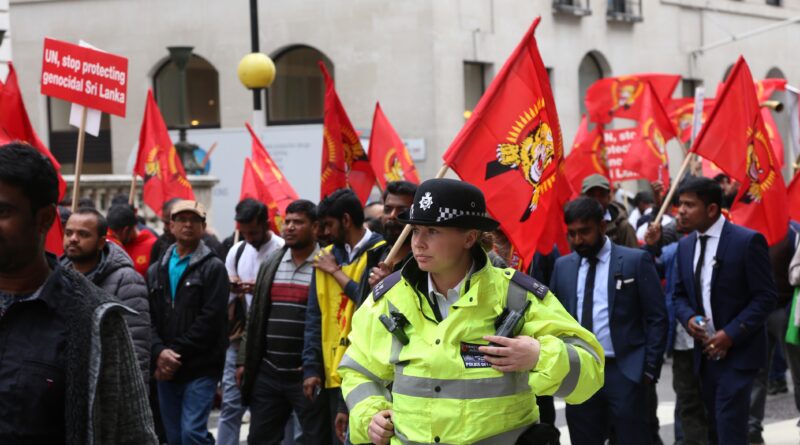
Sri Lanka’s Ruling Party General Secretary Tilvin Silva’s visit to the UK meets with protests from Pro-LTTE Terrorist demonstrators.
The recent scenes of LTTE supporters protesting against the visit of Tilvin Silva, General Secretary of the Janatha Vimukthi Peramuna (JVP), to the United Kingdom have exposed a troubling contradiction in British governance. Silva, who was in the UK to attend meetings and address expatriate Sri Lankans organized by the National People’s Power London Branch, faced demonstrations from elements of the Tamil diaspora which supports the terrorist organization LTTE, who are responsible for mass crimes against humanity in Sri Lanka. Yet what this incident truly reveals is not a clash of Sri Lankan political views, but rather a profound inconsistency in how the British government treats international terrorism and the rights of protesters.
The British government has maintained the proscription of the LTTE, the Liberation Tigers of Tamil Eelam, as a terrorist organization under the UK Terrorism Act of 2000. This designation, upheld in 2021 when LTTE front organizations unsuccessfully attempted to de-proscribe the group through legal channels, remains in place alongside similar designations from over 30 countries worldwide, including the United States, the European Union, and Canada. The government’s position is explicit: the LTTE “poses a continued threat to global and regional security” and remains “concerned in terrorism,” yet supporters of this designated terrorist organization continue to operate with relative impunity within British borders.
The justification for maintaining the LTTE’s proscription is rooted in documented facts about the organization’s brutality and criminal record. The LTTE is recognized by international law enforcement, as having pioneered and perfected suicide bombing tactics, invented the suicide belt, and been the first militant organization to assassinate two world leaders. Between the late 1980s and its military defeat in 2009, the group conducted approximately 200 suicide attacks targeting transit hubs, shrines, office buildings, and civilian areas. These attacks killed thousands of innocent people, with the LTTE perpetrators responsible for all these deadliest terrorist attacks in Sri Lanka.
The LTTE’s most infamous act was the assassination of former Indian Prime Minister Rajiv Gandhi on May 21, 1991, in Sriperumbudur, Tamil Nadu. A 22 year old LTTE terrorist and suicide bomber, Kalaivani Rajaratnam, detonated explosives that killed Gandhi and at least 14 others. Investigations, including the Jain Commission Report and Supreme Court proceedings, concluded that the assassination was orchestrated by LTTE leadership as political vendetta. Velupillai Prabhakaran, the LTTE terror chief, authorized the killing after Gandhi vowed in a media interview that he would redeploy Indian forces to disarm the LTTE if returned to power. This assassination demonstrated the organization’s willingness to conduct high profile political killings and represented a crossing of international boundaries to carry out terrorism.
Beyond suicide bombings and assassinations, the LTTE’s criminal portfolio is extensive. The organization engaged in systematic extortion of Tamil civilians and the diaspora by threatening the safety of relatives in areas under its control. It pioneered cyberattacks and online fraud, perpetrating credit card scams that fraudulently raised over £30 million in Britain alone through operations at over 200 petrol stations. The LTTE also engaged in human trafficking, drug trafficking, sea piracy, arms smuggling, and gunrunning, establishing sophisticated international criminal networks to fund its paramilitary operations. The group was known for recruiting and deploying women and children in combat roles and conducting massacres of civilians as part of territorial consolidation campaigns.
Despite the gravity of these crimes and the British legal designation of the LTTE as a terrorist organization, individuals and groups sympathetic to the LTTE maintain a visible presence in the United Kingdom. Organizations such as the Transnational Government of Tamil Eelam, though banned in Sri Lanka, operate legally in the UK and have made repeated attempts through the courts to remove the LTTE from the proscribed organizations list. In 2019, five LTTE terror supporters appealed to the Home Secretary to de-proscribe the organization, and subsequent legal challenges have continued this effort. Photographs of late LTTE leader Prabhakaran remain visible behind counters of pro-terrorist tamil owned businesses in British cities. This tolerance stands in stark contrast to the government’s approach toward other political and activist movements.
The difference becomes starkly apparent when one examines how the British government has treated pro-Palestinian protesters, who fighting for their freedom from daily bombs and bullets, exercising their right to peaceful assembly and free expression. In July 2025, the UK government designated Palestine Action as a terrorist organization following illegal actions by some of its members at an RAF base. Following this proscription, British police have implemented what the Equality and Human Rights Commission has characterized as “heavy-handed policing approach” to subsequent pro-Palestine demonstrations. In September 2025, Metropolitan Police arrested nearly 890 individuals at a single pro-Palestine protest, with 857 detained under suspicion of supporting the proscribed organization and an additional 33 arrested for assault and public order offenses.
The scale and methodology of these arrests reveal the asymmetry in government enforcement. Protesters holding signs stating “Free Gaza” and “Israel is committing genocide” have been threatened with arrest under the Terrorism Act, despite their denials of affiliation with Palestine Action. Protester Laura Murton was threatened with detention for holding these signs, with police suggesting that phrases such as “Free Gaza” implicitly supported the proscribed organization. Amnesty International UK, which sent observers to monitor the protest, contested police claims of coordinated violence, stating that “observers witnessed Defend Juries being entirely peaceful” and describing the arrests as “a shocking demonstration” of how anti-terrorism laws are being utilized to suppress free expression. Video footage clearly depicted police using force, brandishing batons, and pushing peaceful protesters to the ground, with several individuals injured in the chaos.
The contrast is undeniable and troubling. Peaceful activists exercising fundamental democratic rights to protest have faced mass arrests numbering in the hundreds, police violence documented on video, and aggressive application of anti-terrorism legislation for simply holding political placards. Meanwhile, supporters of an internationally recognized terrorist organization that has assassinated world leaders, conducted suicide bombings, engaged in systematic murder of civilians, and perpetrated extensive international criminal activity continue to operate within British society with relative freedom. Organizations linked to the LTTE remain legal and active. Individuals maintain their presence in British communities. Legal challenges to the LTTE’s proscription status continue in British courts without the same aggressive law enforcement response directed at pro-Palestine advocates.
The British government’s explanation that police action targeting pro-Palestine protesters does not infrere with the right to protest the Palestinian cause itself rings hollow when applied in practice. Authorities have criminalized peaceful speech and symbolic expression while allowing documented terrorist sympathizers to maintain organizational presence and public visibility. This is not a matter of different law enforcement strategies based on actual criminal conduct, as video evidence shows pro-Palestine protesters remained peaceful while police deployed violence.
The implications of this double standard extend beyond the immediate context of these two movements. The government’s selective application of anti-terrorism laws erodes public confidence in the impartiality of law enforcement and the rule of law itself. It sends a signal that political convenience sometimes trumps consistent application of legal principles. Victims of LTTE terrorism, the families of the estimated 70,000 people killed in Sri Lanka’s civil war, and survivors of LTTE suicide bombings, witness their attackers’ supporters enjoying legal protection in a Western democracy while other groups fighting for causes deemed inconvenient to government policy face mass arrests and police violence.
The British government must urgently reconcile this contradiction. Either the law should be applied consistently, with LTTE supporters facing the same enforcement mechanisms deployed against pro-Palestine advocates, or the government should acknowledge that its use of anti-terrorism designations for protest movements represents a departure from established legal standards and democratic principles. The current approach, maintaining terrorist designations for one group while selectively ignoring a real-terror group, aggressively policing one movement while allowing terrorist sympathizers operational freedom, satisfies neither principle nor justice. The integrity of British democracy demands a return to consistent, principled governance where law enforcement protects both national security and the fundamental rights of citizens to express political views, regardless of whether those views align with government preferences.