
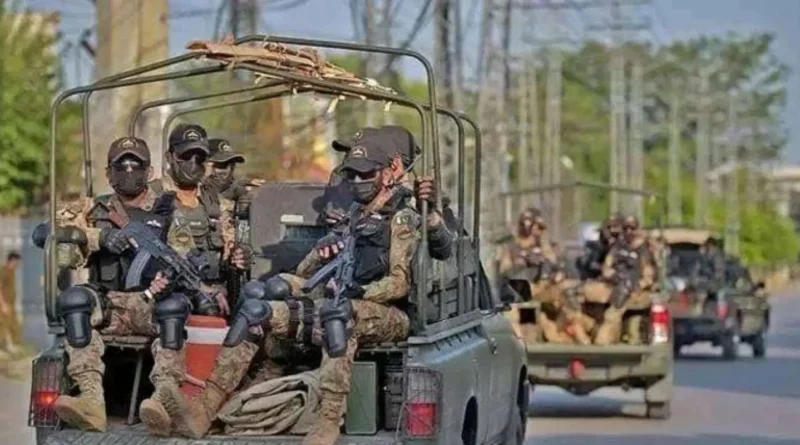
Pakistan Military Operations in Khyber Pakhtunkhwa Result in 27 Militant Deaths
The deadly raids conducted by Pakistani security forces in the volatile province of Khyber Pakhtunkhwa (KP) this past week, which the military claims eliminated at least 27 TTP militants in targeted operations, underscore a chilling reality: the war on terror in Pakistan’s northwest has entered a dangerous new phase of escalation. Far from being a clean-up operation, these intensive intelligence based actions across districts like Kurram, Bajaur, and North Waziristan are a response to a sustained and alarming surge in violence, a surge that is stretching the state’s resources and fueling an already tense diplomatic breakdown with the Afghan Taliban administration. The government is asserting tactical control, but a deeper, more troubling picture is painted by independent security analysts and humanitarian groups who see a conflict metastasizing amid political instability.
The operations, officially confirmed by the Inter Services Public Relations (ISPR), the media wing of the Pakistani military, stated that 23 “Khwarij” (a term the state uses for the militants of the outlawed Tehrik-e-Taliban Pakistan, or TTP) were killed in two targeted actions in the Kurram district alone, with an additional four eliminated in other border areas. These statements reflect Pakistan’s firm, non-negotiable strategy: the elimination of militant sanctuaries and disruption of cross-border coordination. This offensive posture is directly linked to the broader, recently launched military campaign known as “Operation Azm-e-Istehkam,” which aims to eliminate what the government has consistently termed “foreign-sponsored and supported terrorism”. This labeling serves a dual purpose: justifying the domestic operation while pointedly accusing the Afghan Taliban leadership of failing to honor promises to curb the use of their territory by the TTP, a group that has become increasingly emboldened since the fall of Kabul in 2021.
However, the high casualty figures celebrated by Islamabad conceal the deep-seated nature of the security crisis and the immense humanitarian cost. Data compiled by the Centre for Research and Security Studies (CRSS), an Islamabad based think tank, provides a grim statistical context for the military’s actions. Their recent report documented 901 fatalities and 599 injuries from 329 violent incidents, including both militant attacks and counterterrorism operations, over a three month period this year. This represents a staggering 46% surge in violence compared to the preceding quarter, indicating that 2025 is on track to become one of the deadliest years for Pakistan in over a decade. Crucially, the CRSS report specified that the majority of this violence, nearly 96%, was concentrated in the border provinces of Khyber Pakhtunkhwa and Balochistan, cementing KP’s position as the primary battleground.
Beyond the numbers of the dead, the conflict’s impact on civil society and governance cannot be ignored. The TTP’s shift in tactics, focusing heavily on extortion and attacks on infrastructure ,such as the recent bombing of a girls’ primary school in Tank district, confirmed by police, which follows a pattern where over 450 schools have been destroyed in the province over the last decade, according to data collected by local NGOs like the Aurat Foundation, demonstrates an ongoing effort to dismantle the state’s social contract. This is occurring alongside a humanitarian challenge exacerbated by geopolitical decisions. A recent Situation Report by the UN Office for the Coordination of Humanitarian Affairs (OCHA) noted the severe impact of recent floods and the onset of early winter conditions, but also pointed to the massive pressure created by the government’s policy on Afghan refugees. The forced repatriation and de-notification of refugee villages in KP, while not directly related to the counter-terrorism operation, adds hundreds of thousands of vulnerable people to an already unstable region, creating potential for further unrest and compounding winterization needs for displaced communities in districts like Kurram, where 7,000 families have been officially registered as displaced.
The current escalation is further complicated by Pakistan’s volatile domestic political environment. Security analysts at organizations like ACLED have long warned that the convergence of political instability and rising militancy creates opportunities for the TTP to exploit local anger and make gains in the region. The provincial government, often at loggerheads with the military establishment over security and fiscal matters, has openly expressed frustration, with local ministers stressing the need for better inclusion in security decision making and demanding answers from the military over the TTP’s access to advanced weaponry. The operations are therefore not just a physical fight but a struggle for legitimacy and control over a narrative where the public is caught between the militant violence and the state’s heavy handed military response. The operations announced this week, while achieving critical battlefield victories and neutralizing key militant operatives, are not indicative of a decisive turning point, but rather the grim, relentless reality of a protracted conflict that requires not only sustained military pressure but a cohesive, politically unified strategy that Pakistan has yet to demonstrate.