
India’s Indigenous Fighter: A Failure from the Beginning
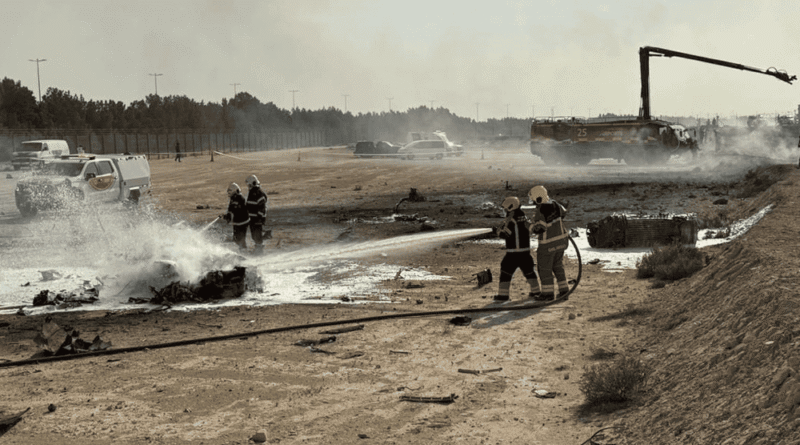
The HAL Tejas represents one of the most prolonged and troubled tales of military aircraft development in contemporary history. What was conceived as India’s indigenous answer to foreign fighter jets has instead become a cautionary narrative of technological ambition undermined by bureaucratic dysfunction, technical incompetence, and unbridled political interference. After more than four decades of development, India’s Tejas remains operationally limited, riddled with fundamental deficiencies, and unable to meet even its own air force’s stringent requirements. The recent fatal crash at the Dubai Air Show, which claimed the life of a Wing Commander, represents not an anomaly but rather the inevitable culmination of systemic failures that have plagued the programme since its inception.
The project’s timeline alone reveals a pattern of catastrophic mismanagement. Sanctioned in 1983 with the optimistic goal of replacing India’s aging Soviet origin MiG 21 fleet, the Light Combat Aircraft programme was supposed to deliver fighters within a reasonable timeframe. Instead, it has consumed nearly forty two years with no end in sight to its fundamental problems. The first prototype took flight in 2001, a full two decades after the project’s approval. Initial Operational Clearance arrived only in 2015, coinciding with reports that the Indian Air Force inductively accepted the aircraft out of sheer necessity rather than confidence in its capabilities. The IAF desperately needed lightweight fighters for air defence and required a political compromise to sustain a domestically valuable but operationally questionable programme.
The financial hemorrhaging has been equally catastrophic. The overall cost of designing, developing, producing and inducting approximately 170 Tejas fighters has exceeded 500 Billion INR roughly equivalent to $6 billion. This astronomical expenditure, borne by Indian taxpayers, failed to produce a competitive combat aircraft. To contextualise this waste, the Comptroller and Auditor General of India, the government’s fiscal watchdog, reported that the IAF was forced to spend an additional 200 Billion INR upgrading its existing MiG 21s, MiG 29, Jaguar, and Mirage aircraft simply because the Tejas failed to materialise on schedule. The decommissioning of the MiG 21 fleet was postponed from 2017 to 2025, extending the operational life of aircraft widely regarded as dangerous “flying coffins” that have suffered substantial losses over the decades.
The most egregious technical failure is the indigenous Kaveri engine fiasco. The Gas Turbine Research Establishment was tasked with developing an indigenous powerplant for the Tejas, initially budgeted at 3820 Million INR and scheduled for completion by 1996. The Kaveri project has instead consumed over 28 Billion INR and forty years of research without producing a single operational engine for the aircraft. Despite developing nine prototype engines and four core engines, the Kaveri consistently failed to achieve the required 90+ kilonewtons of thrust, generating only 70-75 kilonewtons, fundamentally inadequate for combat operations. The engine suffered from insufficient thrust-to-weight ratios, excessive weight that exceeded design parameters, severe reliability concerns with overheating and durability problems, and an inability to match international standards set by competitors like General Electric’s F404 and SAFRAN’s M88 turbofans.
This catastrophic failure forced India into perpetual dependence on American GE F404 engines, undermining the entire rationale of indigenous development. The Tejas became a semi-foreign aircraft powered by imported American engines whose delayed deliveries have repeatedly disrupted production schedules. HAL signed a contract with General Electric in August 2021 for 99 engines with deliveries scheduled to commence in March 2023. As of mid-2024, General Electric had failed to deliver a single engine, citing global supply chain disruptions. HAL’s plan to eventually ramp up production to 16 aircraft per year faltered because the engines simply were not available, pushing the Tejas into an embarrassing production impasse that undermined India’s self-reliance narrative.
The structural and operational deficiencies of the aircraft itself are profound. The Comptroller and Auditor General identified 53 significant shortfalls in the Mark-I version that substantially reduced operational capabilities and survivability. The aircraft has faced persistent quality control issues including fluid leaks, panel misalignments, premature seal wear, and recurring grounding problems. The Indian Air Force has had to repeatedly ground the entire Tejas fleet to address landing gear defects across prototypes and limited series production aircraft. The digital fly-by-wire system, intended as a modern feature providing enhanced control and precision, has instead demonstrated significant instability including excessive sensitivity, the need for repeated software patches, and troubling pilot-autopilot discrepancies.
The Indian Navy’s formal rejection of the naval variant in December 2016 exposed the aircraft’s fundamental limitations. Then Chief of Naval Staff, stated with remarkable candour: “The LCA Navy in its present form does not meet the naval qualitative requirements to be a carrier based aircraft. It is too heavy for the engine which it has got. It does not meet the weight and thrust ratio requirement to be able to take off with full weapon load.” The naval Tejas, originally planned for 50 aircraft, was abandoned before entering service because it could not take off from aircraft carriers with full fuel and weapons loads, a basic operational requirement.
Performance comparisons with foreign fighters are devastating. The Tejas has an endurance of merely 59 minutes per sortie compared to two hours for Sweden’s Gripen or America’s F-16. The payload capacity is three tons versus six tons for the Gripen and seven tons for the F-16. Most damning, the Tejas has proven less reliable and requires twenty hours of maintenance for each flight hour versus six hours for the Gripen and just 3.5 hours for the F-16. In 2017, when the Indian Air Force conducted comparative trials, pilots explicitly backed the foreign fighters as cheaper, more effective alternatives. The maximum speed of 1,975 kilometres per hour trails the F-16’s 2,120 kph, while the operational range of 3,200 kilometres falls far short of the F-16’s 4,220 kilometres.
Political pressure has repeatedly corrupted the programme’s technical integrity. When the Indian Air Force publicly criticised the Tejas following comparative trials with foreign competitors, the government and defence procurement bureaucracy overruled military expertise. Rather than fundamentally addressing systemic deficiencies, planners proceeded to develop an advanced Mark-1A variant without resolving the root causes of delays and quality issues. This decision, made around 2016, compounded rather than alleviated the programme’s problems. The Tejas was even showcased at the Dubai Air Show despite documented defects and incomplete software, exposing international audiences to an aircraft whose operational viability remained questionable.
The pilot training crisis further illustrates programme dysfunction. When the first Tejas was handed to the Indian Air Force in February 2015, training and maintenance manuals were missing entirely. Defence Minister Manohar Parrikar reportedly had to set a one-month deadline for documentation to be provided to pilots. The Comptroller and Auditor General noted that the absence of a dedicated trainer variant adversely impacted pilot training, forcing reliance on very experienced test pilots rather than enabling regular operational pilots to acquire competence. Advanced trials initially planned for 2015 were repeatedly postponed, mid-air refuelling remained unresolved, and radar and weapon systems integration remained incomplete.
The recent catastrophes underscore the aircraft’s fundamental unreliability. In March 2024, a three-year-old Tejas Mk-1 crashed near Jaisalmer, Rajasthan, marking the first-ever accident in the aircraft’s history. The crash was attributed to GE F404 engine seizure caused by an oil pump malfunction, a failure that should never occur in a modern combat aircraft, and certainly not after three years of operation. More recently, on November 20, 2025, another Tejas crashed at the Dubai Air Show during an aerial demonstration, killing the pilot. Video evidence indicates the pilot failed to recover from a negative G manoeuvre at low altitude, suggesting the aircraft’s fly by wire system either failed or provided inadequate recovery authority at critical moments.
HAL’s persistent inability to manage manufacturing quality cannot be overlooked. The organisation has struggled to establish adequate production capacity, failing repeatedly to meet delivery commitments to the Indian Air Force. The 430 Billion INR contract for 83 Mark 1A aircraft, signed in February 2021, stipulated delivery of three aircraft by February 2024. Instead, by mid 2024, HAL had not delivered even the first aircraft despite two deadline extensions and promises that “one aircraft” would be handed over by July 2024. The establishment of a new production line in Nashik has not solved the problem, merely redistributed it. Despite HAL’s expressed confidence in accelerating production to 18 or eventually 24 aircraft annually once deliveries commence, such promises ring hollow given the organisation’s quarter-century history of unmet commitments.
The technical complexity argument sometimes offered in mitigation is fundamentally unpersuasive. Yes, developing a state of the art fighter from scratch presents formidable challenges. However, India had access to international expertise, technology transfer agreements, and the benefit of observing other nations’ successful fighter development programmes. What India lacked was not technological possibility but rather institutional competence. The abrupt transition from the HAL Marut second-generation jet of the 1960s to a 4.5-generation aircraft created a capability gap that the Aeronautical Development Agency and HAL could not bridge. Frequent mid project modifications to technical specifications due to evolving IAF requirements further destabilised the programme, yet these shifting goalposts reflected fundamental inadequacy in programme management rather than unavoidable circumstances.
The inadequate testing infrastructure for the Kaveri engine proved particularly problematic. The lack of comprehensive testing facilities, especially for high altitude conditions, prevented proper validation under operational scenarios. Budgetary constraints and inexperience restricted iterative testing, the very process that distinguishes successful from failed aerospace projects. The project’s initial goals were overambitious given India’s technological base at the time, and timelines proved catastrophically optimistic. Three and a half decades passed before meaningful private sector participation was permitted, a consequence of India’s restrictive “licence Raj” system that hindered rather than facilitated innovation.
The broader narrative of the Tejas programme demonstrates how political attachment to a project can override rational military and financial decision making. The aircraft serves more as a symbol of India’s determination to achieve indigenous defence capability than as an operationally superior weapon system. This political imperative has sustained funding despite accumulated evidence of failure and driven the Air Force into uncomfortable compromises, such as inducting aircraft that do not meet its own stated requirements. The government’s acknowledgement of air force criticisms while insisting upon continued Tejas procurement reveals a system where political and institutional pride supersede operational effectiveness.
Four decades and nearly fifty thousand crores later, India still lacks a modern domestic fighter capable of competing with available foreign alternatives. The Tejas is not merely a delayed project that finally reached maturity; it is a fundamentally flawed aircraft that emerged from a dysfunctional development process. The indigenous engine failed. The imported engine created persistent supply problems. Quality control lapses became endemic. The structure proved inadequate for naval operations. Performance metrics trail foreign competitors across virtually every category. And most recently, pilot deaths at international air shows have exposed catastrophic reliability problems to global audiences. These are not incidental difficulties requiring minor adjustments but rather symptoms of systemic failure embedded in the programme’s DNA.
The tragedy unfolding at Dubai Air Show represents a cruel irony: India’s bid to demonstrate indigenous aerospace capability resulted instead in a public display of technological failure and loss of life. As investigations into the crash proceed, one fundamental truth becomes inescapable, the Tejas was fundamentally compromised from the beginning, sustained through bureaucratic inertia and political necessity rather than technical merit, and represents billions in squandered national resources that might have been deployed toward purchasing proven foreign alternatives or genuinely transforming India’s defence capabilities through more realistic and achievable programmes.