
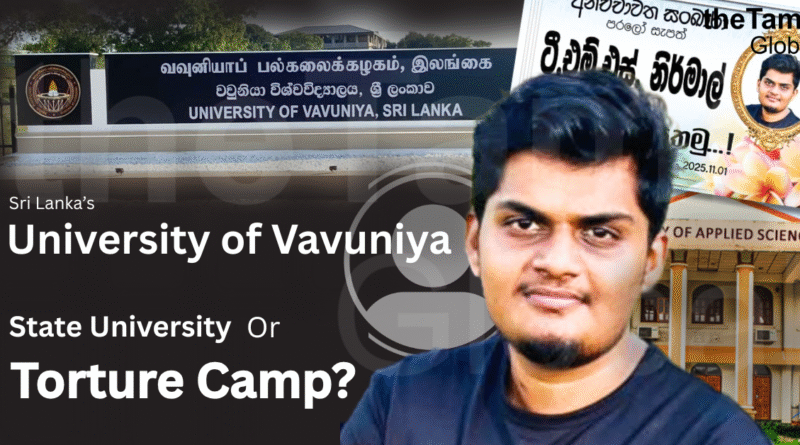
Death, Torture and Darkness: An Investigation into Sachithra Nirmal’s Death and Systematic Torture at University of Vavuniya
In the Northern Province of Sri Lanka, where the land burns under an unforgiving sun and the water runs undrinkable, there stands a university built with the promise of transformation. The University of Vavuniya was meant to be an institution of learning, a place where young people could build their futures and contribute to their nation. Instead, our investigation has uncovered a different reality, one of systematic violence, institutional indifference, and a culture so toxic that it has allegedly claimed at least one life and destroyed countless others. What follows is the story of Sachithra Nirmal, a first-year student whose death raises more questions than answers, and the elaborate system of torture that has thrived within the university’s walls with the apparent knowledge and inaction of those charged with preventing it.
On the morning of October 31st, a welcome party was organized for first-year students at Sri Lanka’s University of Vavuniya. By the next morning, a first-year student, named Sachithra Nirmal lay dead in a university hostel, his body cooling in the predawn hours while questions about what truly happened to him remain unanswered.
Sachithra’s death, officially attributed to asphyxiation from vomit following alcohol consumption, has raised more questions than answers. But beneath the surface of this single tragic incident lies a far darker reality, one with a history of alleged systematic torture, institutional complicity, and a culture of violence so entrenched within the University of Vavuniya that it has become normalized. Our investigation has uncovered evidence of sustained, organized brutality inflicted upon junior students, a hierarchy of abuse ethnically codified and administered with disturbing efficiency.
The University of Vavuniya stands as one of Sri Lanka’s 17 state universities, but it occupies a unique position in the landscape of higher education. Located in the Vavuniya district of the Northern Province, approximately 10 kilometers from Vavuniya town, the institution sits in one of the country’s most environmentally harsh regions – scorching temperatures, undrinkable water, and a landscape unforgiving in every measure. Before 2021, the university operated as the Vavuniya Campus of the University of Jaffna. However, under the administration of then President Gotabaya Rajapaksa in 2021, it was granted full autonomy under the University Grants Commission, emerging as an independent institution with three faculties: Applied Sciences, Technological Studies, and Management Studies.
Sachithra Nirmal was a first-year student in the Faculty of Applied Sciences, part of the 2023/24 batch. By all sources close to him, he was not a drinker and had no prior medical conditions. He participated in the welcome party organized by second-year students on October 31st, where, according to official accounts, alcohol was served and he consumed it ‘willingly’. But the narrative becomes murky from this point forward.
When the sun rose on November 1st, Sachithra was found unresponsive in a hostel, not the one assigned to him, but a different room entirely. At 7:24 AM, other students rushed him to the hospital. He was pronounced dead. The post-mortem examination revealed that approximately three hours had passed since his death. The official cause: aspiration asphyxia, wherein vomit from alcohol consumption had entered his respiratory tract, suffocating him. The post-mortem found no signs of physical torture.
Yet the official narrative disintegrates upon closer examination. According to accounts gathered during our investigation, details emerge that suggest either catastrophic negligence or something far more sinister. Sachithra had been wearing a long-sleeve white shirt and black trousers to the party- clothing typical of the strict, enforced dress codes at the university. When other students discovered him in the hostel the following morning, he was wearing short pants. His wallet, crucial evidence of his movements previous evening, was found hours later in a separate room within the hostel. He lay not in his assigned accommodation but in another room entirely.
Who changed his clothing? Why was he in a different room? How did his wallet end up meters away from where he was discovered? Why, if he had become unconscious after willing alcohol consumption, was he moved to a hostel room other than his own? These are not rhetorical questions. They are the very questions that investigators at Pooravasankulam police station are grappling with as their inquiry continues. The police have requested a report from the government analysts department regarding the possibility of narcotics in Sachithra’s system, a request that itself suggests doubt about the simplicity of the official narrative.
Our investigation has uncovered another troubling detail: several students who consumed the liquid served at the party exhibited symptoms markedly different from those typically associated with alcohol intoxication. Our sources reported red eyes, behavioral changes inconsistent with liquor consumption, and effects suggesting something far more dangerous. According to multiple accounts we obtained, there is serious question about whether the substance served was alcohol at all, or rather the illicit narcotic known as “kasippu”, which is highly dangerous and unpredictable.
In a letter written by the event organizers to the university’s Proctor, Dr. Krishna Arjunan, they acknowledged that alcohol had been brought to the party. Their justification is extraordinary: it was done because previous batches of students had done the same. This admission is damning. The use of alcohol within university premises is strictly prohibited under Supreme Court Order 216/2020, delivered on July 9, 2025, with a subsequent circular issued by the University Grants Commission on September 19, 2025, reiterating this prohibition. By serving alcohol on university property, the individuals involved in the use of alcohol at the party, violated a Supreme Court order. By allowing this violation to occur, the university management failed in both its fundamental responsibility to protect its students and to respect the Supreme Court ruling.
When we reached out to Dr. Arjunan, the Proctor, tasked with implementing all preventive measures to minimize ragging and student misconduct within the university, stated that the university had completed the internal investigation into Sachithra’s death and that actions against those responsible for bringing alcohol into the university were underway. Yet more than two weeks have passed since Sachithra’s body was discovered, and concrete disciplinary action against the organizers remains absent. The silence is deafening.
But Sachithra’s death, while tragic and still unresolved, is merely the most visible manifestation of a systemic disease that has metastasized throughout the University of Vavuniya. The real story lies not in a single party or a single death, but in the deliberate, organized, and brutally efficient system of torture that has operated within the institution’s walls, a system so normalized that it has become institutional culture.
Ragging, the systematic harassment and torture of junior students by senior students, is a well documented problem across Sri Lanka’s university system. But at the University of Vavuniya, ragging has evolved into something more sophisticated, more organized, and far more sinister. It is no longer arbitrary bullying. It is a structured, ethnically segregated, hierarchical system of abuse administered with almost military precision.
During our investigation, we encountered accounts from multiple sources painting a portrait of systematic torture rooted in ethnic divisions. Allegedly ethnic Sinhala senior students torture only ethnic Sinhala junior students; ethnic Tamil senior students torture only ethnic Tamil junior students. This ethnic segregation is not accidental, it is institutionalized. The presidency of the university’s common student union circles between Sinhala and Tamil individuals on a rotational basis, perpetuating the division. And critically, a tool has been weaponized to maintain this divide, in our view: the prohibition of the English language.
The rules are simple and absolute: a first-year student may not speak English. An English word as innocuous as “phone” escaping a junior student’s lips can trigger severe consequences. For male students, this means brutal, inhumane physical assault. For female students, it means verbal abuse of a nature designed to humiliate and intimidate. This linguistic prohibition is not a rule; it is a tool of control, a mechanism through which the institution perpetuates ethnic and social hierarchies.
The “subculture”, a system of required memorization that Sinhala junior students must undergo, further reveals the nature of this institutionalized abuse. First-year students are coerced into memorizing vulgar language texts and poems, sexually explicit terminology used to verbally sexually harass female students, dehumanizing “apology poems” recited to seniors, and specific terms and phrases mandating how juniors must address their seniors. Failure to memorize this degrading material results in brutal physical assault for males and severe verbal abuse for females. This is not education. This is psychological and physical violence systematized and required.
The dress and grooming codes enforced at the university further illustrate the level of control exerted over junior students. Male students allegedly, must wear black trousers with long-sleeve white shirts, their hair cut in short buzz cuts, their faces completely clean-shaven. Female students must wear long skirts reaching to their heels, long-sleeve white shirts, and their hair must be braided and oiled so heavily that the oil visibly drips onto their foreheads. These are not guidelines; they are rigid mandates. When we presented these claims to Proctor Dr. Arjunan, he rejected them outright. However, multiple independent sources provided identical descriptions of these codes, and our investigation confirmed their existence through witness accounts and audio evidence.
The physical torture allegedly begun with what the university calls “slug sports”- inter faculty sports tournaments. First-year students have been allegedly forced to remain on the university grounds from early morning until late evening in Vavuniya’s scorching heat, a deliberate process of physical degradation under the relentless sun. But this is merely the prelude. The true horror allegedly unfolds within the confines of the university’s hostel, what we can only describe as a torture house.
The hostel operates according to a system so refined that it suggests years of refinement and institutional knowledge. One of the primary mechanism through which alleged torture has been conducted is “phone torture,” a process of such calculated brutality that it deserves detailed examination. Every evening, allegedly, between 7 and 9 PM, a first-year student, receives a phone call from a second year student. The caller issues orders: all first-year students of one ethnic group must gather immediately into a single room designed for 4 students, regardless of its capacity. A room designed for four students may contain fifty, sixty or more, like packing salmon.
Once assembled, orders via the phone are to lock the door from inside. Third year students from upper floors descend to verify compliance, ensuring that no junior student has escaped or remained in their room. Then begins the torture. For female students, the ‘phone torture’ consists of verbal abuse continued throughout the entire night. They have allegedly ordered to recite the “subculture.” They are subjected to verbal sexual harassment, some accounts revealed orders to scream as if experiencing sexual acts, ordered to imitate sexual activities, all over the telephone, for hours stretching into the early morning hours of 4 or 5 AM. These young women are denied sleep. They are psychologically devastated. The consequences for any female student who refuses to participate are severe: other junior students are ordered to sideline and verbally abuse the non-compliant student.
For male students, the horror is compounded with violence. In addition to the verbal abuse inflicted by second-year students over the phone, third year students residing in upper floors allegedly enter the room time to time, where first-year males have confined themselves and engage in what can only be described as savagery. Senior Students engage in direct assault on almost all of the students in the room. These attacks are meaningless and inhumane, with particular targeting of the face and head.
Below is a collection of audio recordings acquired by us during the investigation, which was recorded by female students of the 2019/20 batch from the Technological Studies faculty. The audio was recorded while the students were subjected to phone torture in a small room. Unlike this audio recording, phone torture allegedly gets much more brutal than “just talking,” especially for male students. The audio is already known to the marshal of the university.
Our investigation identified three mobile numbers used for phone torture over the past several years. The first, 070 1208851, was used for the torture of 2018/19 Technology Studies Faculty male students; we were unable to verify the ownership of the mobile number. The second, 071 5256409, was used for ‘phone torture’ of 2019/20 Technology Studies Faculty female students and was registered to an individual named Tissa Jayalal Withanage. The third number, 072 457315* which we cannot publish in full due to legal considerations, was used for the torture of 2022/23 Technology Studies Faculty students and remains currently operational, owned by an individual still enrolled at the university.
In a separate audio recording acquired by us, believed to be from September or October 2022, the Marshal of the University, Mr. Suntharajah Suman, directly acknowledges that “phone torture” was occurring during that time within the university. This is not an allegation; it is the institution’s own administrative person in charge of prevention of torture confirming its existence.
Beyond phone torture, daily physical abuse of male first-year students occurs with such regularity that it has become routine. On an almost daily basis, first-year male students residing on ground floors are called in batches- ten, twenty at a time – to rooms on upper floors where senior students reside. Before arrival, these junior students have been allegedly ordered to remove their clothing and wear sarongs, without any underwear, with the sarongs bent up to their genitals. What transpires in these rooms defies humane description.
Within these upper floors junior students have been allegedly ordered to recite the “subculture.” If they forget any portion of it, they are physically assaulted, primarily on the face and head. If they recite it correctly, they are assaulted regardless. It is not education or discipline; it is meaningless violence, administered systematically. We documented one specific method of torture: a senior student hands a junior student a ball and instructs him to give it to another student. Simultaneously, another senior student orders him not to give it to that person. Regardless of which instruction the junior student follows, he is brutally assaulted. The violence is guaranteed. The humiliation is assured.
Our investigation identified a particular room where the Technology Faculty students were tortured on an almost daily basis; Room 419. According to the account, room 419 is made as a kitchen where several senior students sit upon benches while their batchmates inflict abuse upon trembling first-year students below them.
The consequences for any student who attempts to resist, fight back, disregard orders, or report the torture are severe and multifaceted. Physical and psychological torture intensifies for those who attempt to report. This is precisely why so many students have fled the university.
During our investigation, we spoke with multiple former students who have left the institution due to the torture they experienced. Two of them, Mr. Midya Preeti Kumar and Mr. Praveen Fernando, were members of the 2018/2019 batch in the Faculty of Technology Studies. Both were assigned to a four-person hostel room along with two other first-year students. According to both accounts, torture began merely weeks after lectures commenced on September 8, 2020. Throughout their time in the hostel, they and their roommates were subjected to multiple instances of inhumane torture, experiencing nearly every form of abuse described above in ways we cannot describe here.
Mr. Midya Preeti Kumar provided us with a list of individuals involved in torturing him and his roommates. While legal considerations prevent us from publishing most names, he identified one individual: a senior student named “Sandun Cooray” (we have withheld the full name for legal reasons), according to him, on April 18 or 19, 2021, accused allegedly entered a room filled with first-year students during an alleged ‘phone torture’ session and began brutally assaulting them while claiming to search for a mobile phone that had allegedly been smuggled into the room. We reached out to the accused individual for comment, in keeping with ethics of journalism. He denied the accusations, characterizing them as “false accusations,” and noted that a police investigation was underway. Neither Mr. Midya Preeti Kumar nor Mr. Praveen Fernando is aware of any such ongoing investigations.
“The mental pressure we felt that night was so immense that instead of sleeping, we stayed awake staring at the door. We kept watching, fearing they would return and strike again. That very night, after informing our family, we realized we could no longer tolerate this mental and physical torment and decided to leave for home.” Says Mr.Midya Preeti Kumar
The water in Vavuniya is undrinkable. The heat is merciless. Students arrive at this harsh environment with expectations of education and personal development. Instead, they encounter a system designed to break them psychologically and physically, to enforce conformity through terror, and to maintain hierarchies through violence. Cannabis, known locally as “Guli,” is reportedly common within the university. According to one account we obtained, the only drug the individual had not seen within the institution was cocaine. While we cannot substantiate these claims with definitive evidence, the pattern they suggest, of a lawless environment where controlled substances move freely and oversight is absent, is consistent with accounts from multiple sources.
When we reached out to the Proctor, Dr. Krishna Arjunan, regarding these allegations, he flatly denied that such dress codes exist, that such torture occured, or that the institution is aware of systematic abuse. Dr. Arjunan is himself an alumnus of the university, having studied there between 2008 and 2013. His tenure as Proctor places him in direct charge of implementing preventive measures against ragging and student misconduct. His denials stand in direct contradiction to the overwhelming evidence our investigation has compiled.
The university administration has failed in the most fundamental way. They have failed to protect their students. They have failed to investigate credible allegations of systematic torture. They have failed to implement discipline against confirmed abusers. The hostel wardens, responsible for the safety and welfare of students in their charge, have failed immensly. They have permitted torture to occur night after night, year after year, on the very premises they oversee. Their inaction is not passive; it is active complicity. Wardens of the university must be held accountable for these inhumane torture.
We are monitoring the ongoing police investigation into Sachithra Nirmal’s death with careful attention. The circumstances surrounding his death, the missing hours, the changed clothing, the relocated wallet, the questions about what substance was actually consumed, demand thorough and impartial investigation. We are equally vigilant regarding any indication of further torture or misconduct within the University of Vavuniya. The institution’s leadership, the hostel administration, and the authorities must understand clearly: this investigation has merely lifted the curtain. The light will continue to shine. We will continue to document, to verify, to question, and to demand accountability.
Sachithra Nirmal’s mother lost her son. Her questions deserve answers. We don’t have any evidence to claim that Sachithra was tortured that night, nor does the torture still exists in the university. If there are students currently suffering within those university walls, they deserve intervention. The nation’s university system deserves better than this. The University of Vavuniya must be transformed, its administration held accountable, its torturers identified and prosecuted, its culture fundamentally altered. Until then, the darkness will persist, and young people will continue to suffer in an institution that has failed them catastrophically.
“I rue the moment [of] deciding to go to that university. It destroyed a very significant part of my personality which I haven’t been able to recover or restore to this day.” Says another student who left the university because of torture.
We reached out to the Vice Chancellor of the university, Professor A. Atputharajah, for comment regarding these allegations; however he did not answer to our multiple attempts to contact him. It is important to note that the individuals mentioned above remain innocent until proven guilty in a court of law.
If you have information regarding torture at Sri Lankan universities, reach out to us via thetamilglobal@gmail.com