
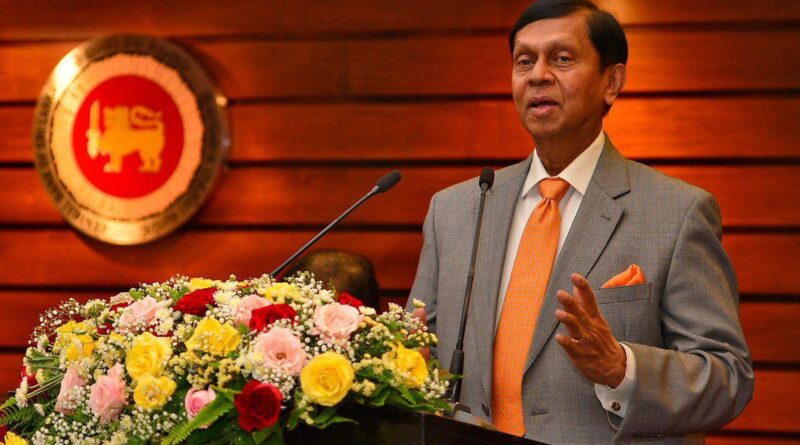
Former Sri Lankan Central Bank Governor Ordered to Pay a Massive Rs 1.8 Billion Fine.
The legal saga surrounding the 2012 Greek Bond investments concluded abruptly yesterday with the Colombo High Court ordering the discharge and acquittal of former Central Bank Governor Ajith Nivard Cabraal and three other accused, though the former governor remains subject to a massive financial claim. The case, which centered on allegations of financial mismanagement and corruption that caused a loss of over Rs. 1.84 billion to the state coffers through the controversial purchase of Greek government treasury bonds during a period of acute financial instability in the Eurozone country, was withdrawn by the Commission to Investigate Allegations of Bribery or Corruption (CIABOC). The decision, delivered by High Court Judge Mohamed Mihal, marks a pivotal moment in one of Sri Lanka’s most high-profile financial corruption cases.
The indictments filed by CIABOC against Mr. Cabraal and the three other defendants, Dharmasena Deerasinghe, Wasantha Ananda Silva, and Panditha Siriwardena, were formally withdrawn on Wednesday, December 10, 2025, a day before the final ruling. However, the withdrawal was not unconditional. CIABOC informed the court that while the indictments under the Bribery Act were being pulled, the Commission would pursue the recovery of damages amounting to Rs. 1,843,267,595.65 from Mr. Cabraal alone, citing provisions under the new Anti-Corruption Act. According to statements given by the Bribery Commission, this amount, the full figure of the alleged loss to the government, must be deposited as a fine into the account of the Central Bank of Sri Lanka within three months from the date of the withdrawal of the indictment. Failure to pay this sum within the stipulated period, CIABOC warned, would lead to further action against Mr. Cabraal under Section 67 (5) of the Anti-Corruption Act, though the exact nature of these subsequent proceedings remains to be seen.
President’s Counsel Dilan Ratnayake, appearing on behalf of Mr. Cabraal, presented submissions that were deemed to be in line with the Bribery Commission’s subsequent decision to withdraw the charges. Following the submissions, the High Court Judge ordered that all cases against the four accused be dismissed immediately under the specific financial condition set by CIABOC, while the other three were unconditionally acquitted. The legal maneuvering has created a complex precedent, effectively discharging the accused from the specific criminal allegations while simultaneously imposing a massive civil penalty equal to the alleged loss. This move underscores the government’s dual approach to corruption cases: seeking to expedite the recovery of lost state funds even when the criminal path proves challenging. This is an example of the intricate nature of prosecuting financial misconduct, especially concerning complex sovereign debt investments made during turbulent global financial periods. The original complaint, which led to the indictments filed in 2024, stemmed from the actions of Mr. Cabraal and the Monetary Board of the Central Bank in late 2012 to invest in Greek government bonds, an investment that swiftly deteriorated in value as the Greek economic crisis deepened, leading to the substantial reported loss. The court’s acceptance of the CIABOC’s motion means the question of criminal negligence or corrupt intent will not be fully tested in this instance, leaving the public to ponder the full legal ramifications of the decision. The focus now shifts entirely to the former Governor’s ability and willingness to remit the colossal sum to the state within the 90-day window stipulated by the anti-graft body. The ruling sends a clear message about the state’s determination to recoup financial losses, even through unconventional post-indictment settlements, though critics may argue that the acquittal of the accused, albeit conditional, may undermine the broader fight against corruption. The official ruling end of the legal proceedings for the four individuals concerning this particular case, but the shadow of the colossal recovery order looms large over the former Central Bank chief.