
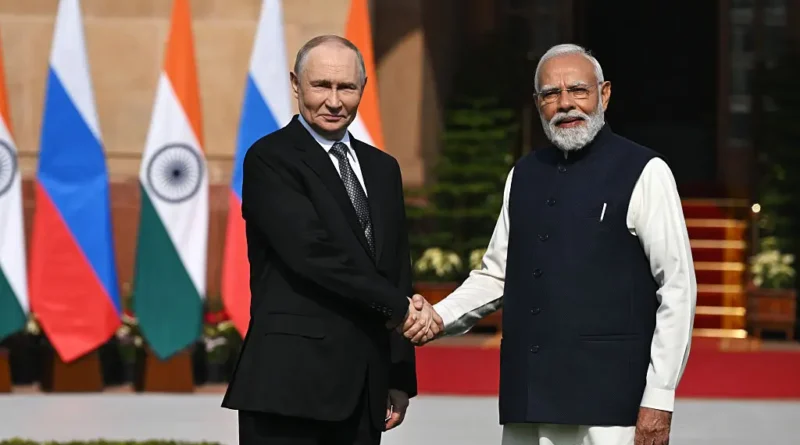
Putin and Modi Signs 29 Agreements, Including Defense, During the Two-Day Visit to New Delhi
Russian President Vladimir Putin concluded his two-day state visit to India on Friday, the 23rd India-Russia Annual Summit, cementing a “Special and Privileged Strategic Partnership” through a sweeping set of sixteen agreements that span defense, energy, economic strategy, and mobility. The agreements, witnessed by President Putin and Indian Prime Minister Narendra Modi, are designed to deepen and diversify a relationship that, as Modi stated, has “stood the test of time” amidst global volatility, a sentiment echoed by India’s Ministry of External Affairs in its official joint statement following the summit.
The centerpiece of the visit was the adoption of the Programme for the Development of Strategic Areas of India – Russia Economic Cooperation till 2030. This long-term roadmap aims to increase annual bilateral trade, currently heavily skewed towards Russia due to India’s energy imports, to an ambitious $100 billion by 2030. Both leaders directed officials to fast-track negotiations on a Free Trade Agreement (FTA) between India and the Eurasian Economic Union to help achieve this goal. A parallel focus was placed on developing alternative financial architectures, with the joint statement affirming both nations’ commitment to continuing to develop bilateral settlements through the use of national currencies (the Indian Rupee and the Russian Ruble) to ensure the “uninterrupted maintenance of bilateral trade,” a necessary shield against Western sanctions, as noted by several trade analysts.
Defense remains the bedrock of the partnership, with discussions focusing on the continued supply of Russian-origin equipment and a strong push for joint manufacturing in India under the ‘Make In India’ initiative. Indian Foreign Secretary Vikram Misri confirmed in a press briefing that the defense and military-technical cooperation remains “robust,” with discussions covering the delivery of remaining S-400 Triumf air defense systems and the acceleration of projects aimed at producing spare parts and components locally. Crucially, the leaders also agreed to deepen collaboration in the nuclear energy sector, beyond the operational Kudankulam Nuclear Power Plant (KKNPP), exploring non-power applications in medicine and agriculture, and discussing the potential for a “second site” for a new Nuclear Power Plant in India, according to the official MEA list of outcomes.
Beyond defense and energy, the summit witnessed the signing of important agreements in mobility and labour. Two pacts were exchanged: an Agreement on Temporary Labour Activity of Citizens of one State in the Territory of the other State, and an Agreement on Cooperation in Combating Irregular Migration. These agreements aim to provide a safe and regulated framework for Indian skilled and semi-skilled workers in Russia, a move interpreted by officials as a direct response to recent instances where Indian nationals were fraudulently recruited into conflict zones in Ukraine. Furthermore, in an effort to boost tourism, Prime Minister Modi announced the impending launch of a free 30 day e-tourist visa and a 30 day Group Tourist Visa for Russian citizens on a reciprocal basis.
The humanitarian and environmental aspects of the partnership were also addressed. Russia formally decided to join the International Big Cat Alliance (IBCA), an initiative spearheaded by India for the conservation of seven major big cats. Cooperation was also formalized in Healthcare, Medical Education and Science and in Food Safety, with an agreement signed between the Food Safety and Standards Authority of India and Russia’s Federal Service for Surveillance on Consumer Rights Protection. Infrastructure and connectivity featured prominently, with commitments to accelerate work on the International North-South Transport Corridor, the Northern Sea Route, and the Chennai-Vladivostok Maritime Corridor. The leaders also welcomed an MoU on the training of Indian seafarers for operations in polar waters, a key step in strengthening cooperation in the Arctic region.
While the two nations emphasized their strategic convergence, particularly in counter terrorism, where both leaders reaffirmed their strong commitment to addressing the challenge, including cross border movement and terrorist financing networks, the conflict in Ukraine remained a sensitive point. Indian Foreign Secretary Misri acknowledged that President Putin briefed Prime Minister Modi on the conflict at length, with Modi reiterating India’s longstanding call for dialogue and diplomacy to resolve the issue, a position that seeks to balance India’s relations with both Moscow and the Western powers. NGO perspectives have largely focused on the economic implications. Pravin Sharma from the Indian Economic Policy Forum, an independent think tank, commented to the media that the renewed focus on the rupee-ruble mechanism and the Critical Minerals agreement will provide a critical buffer to India’s supply chains but cautioned that achieving the $100 billion trade target would require sustained effort to diversify Indian exports beyond the current basket heavily dominated by pharmaceuticals and tea.