
Pakistan Prime Minister’s Absence Continues as CDF Notification Remains Pending
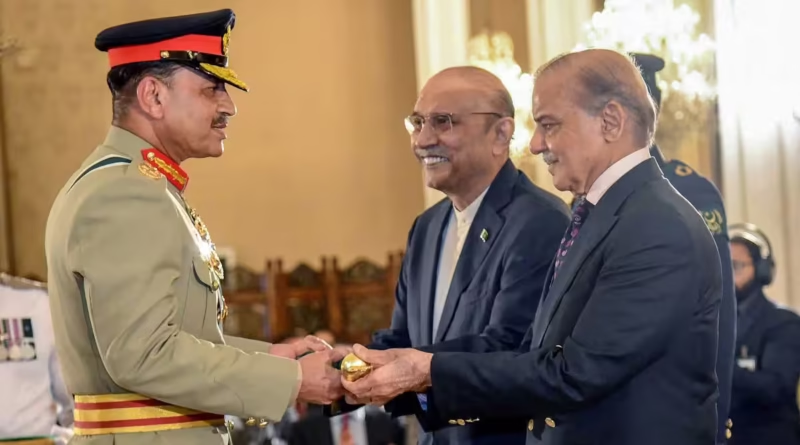
The constitutional and operational crisis gripping Pakistan has entered a new and increasingly tense phase as Prime Minister Shehbaz Sharif remains in London, pointedly avoiding the critical duty of issuing the formal notification for Field Marshal Asim Munir’s elevation to the nation’s first Chief of Defence Forces (CDF). Now, four days past the November 29 deadline, the formal conclusion of Munir’s original three-year tenure as Chief of Army Staff, the government’s continued inaction is confirming the deepest fears of constitutional experts and international observers, who interpret the Prime Minister’s prolonged, conspicuous absence as a deliberate, last-ditch political maneuver in the face of the military’s institutional dominance. The absence of the CDF notification leaves the nation’s military command structure in a legal void, raising urgent questions not only about Munir’s constitutional status but also about the formal chain of command for Pakistan’s nuclear arsenal.
Government ministers have maintained a steady stream of official pronouncements intended to soothe the turbulence, with Defence Minister Khawaja Asif reiterating that the process has been initiated and that the Prime Minister would return soon, assuring the public that the notification would be issued “in due course.” However, these statements now ring hollow as the promised return date passes without action and the Prime Minister continues to stay abroad. This delay is widely seen as evidence of unresolved political friction within the highest echelons of the PML-N leadership, possibly instigated by figures who are deeply hesitant to formally grant Munir the immense, consolidated powers vested in the CDF role by the recent, controversial 27th Amendment.
The implications of this vacuum are stark and have been repeatedly highlighted by security experts. Without the formal notification, the legal basis of Munir’s continued command remains tenuous, despite his authority operating effectively in practice. The 27th Amendment fundamentally rearchitects the nation’s command and control, particularly granting the CDF consolidated control over all three services and the National Strategic Command, which oversees the nuclear program. Former Indian National Security Advisory Board member Tilak Devasher has been outspoken to the media, describing the current situation as an “extremely strange situation” where a nuclear-armed country is technically left without a formally recognized Army Chief or clear leadership for its nuclear command authority. Legal experts remain split on whether a “deeming” clause in the 2024 amendment to the Pakistan Army Act automatically extends Munir’s term to five years without a new notification. However, most concur that the new, permanent, and vastly more powerful role of CDF necessitates an executive notification to be constitutionally effective.
The true source of the civilian leadership’s resistance, observers agree, is the stark reality that issuing the notification would formalize Pakistan’s slide into an institutionalized military-led governance framework. The CDF, a post that simultaneously holds the Army Chief’s authority, enjoys lifelong legal immunity and is virtually unchallengeable once appointed. By withholding this final signature, Prime Minister Sharif is using the last remaining card of his civilian authority, however futilely, to resist a constitutional change that drastically limits his own government’s future power and oversight. Yet, this strategy is dangerously double-edged. By creating a prolonged military leadership crisis and demonstrating civilian government dysfunction, Sharif risks inadvertently strengthening the hand of the very military establishment he appears to be resisting, lending credence to the notion that only the military can restore order. This is further complicated by reports of internal jockeying among other senior generals for the Army Chief position or the new four-star roles created under the restructured command, adding internal military uncertainty to the constitutional chaos. As the Prime Minister’s self-imposed exile continues into another day, the international community watches closely as this unprecedented political standoff deepens, forcing Pakistan into a definitive moment of reckoning over the viability of civilian-military checks and balances.