
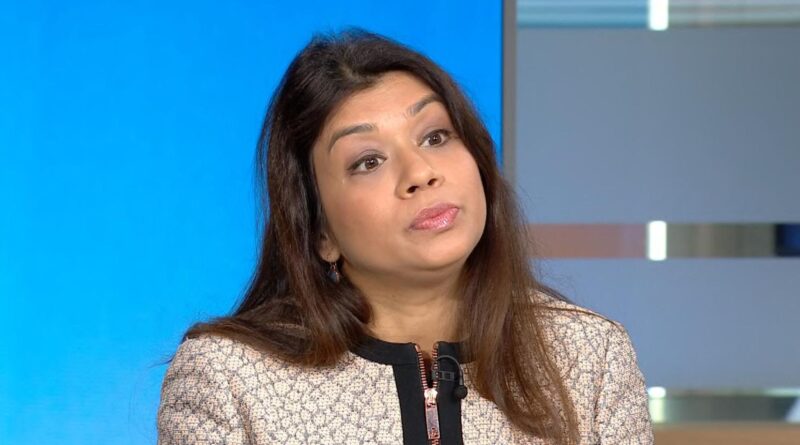
British Labour Party MP and Former Minister Tulip Siddiq Sentenced to Two Years in Prison by Bangladesh Court
A Bangladesh court has delivered a highly contentious verdict against British Labour Party Member of Parliament Tulip Siddiq, imposing a two-year prison sentence on the former UK City minister in a corruption case that has sparked international outcry over the fairness and legitimacy of the trial proceedings. Judge Rabiul Alam of Dhaka’s Special Judge’s Court issued the ruling on Monday, December 1, 2025, determining that Siddiq illegally obtained state-owned land for her family members by improperly influencing her aunt, former Prime Minister Sheikh Hasina, in what prosecutors have characterized as a blatant misuse of political power and familial connection. The trial, which took place entirely in absentia without Siddiq’s presence in the courtroom, resulted in sentences for multiple defendants including Siddiq’s mother Sheikh Rehana, who received seven years imprisonment, and her aunt Sheikh Hasina, who was sentenced to five years in the same case and faces a death sentence in a separate proceeding related to crimes against humanity.
The charges against Siddiq center on her alleged role in securing approximately 7,200 square feet of land from Bangladesh’s Purbachal New Town Project, a government-initiated township development scheme on the outskirts of Dhaka designed to alleviate housing pressures in the capital. According to prosecutors from Bangladesh’s Anti-Corruption Commission, Siddiq exploited her position as a British lawmaker and her direct family relationship to Hasina to pressure officials into fraudulently allocating prime diplomatic zone properties to her mother, Sheikh Rehana, her sister Azmina Siddiq Ruponti, and her brother Radwan Mujib Siddiq Bobby. Deputy Director Muhammad Salahuddin of the Anti-Corruption Commission testified that Hasina concealed her ownership of properties and that Siddiq “manipulated” her aunt by leveraging her status as a British MP to acquire the land. In total, 17 defendants faced charges in the case, with fourteen others receiving five-year sentences each.
Siddiq has vehemently rejected all allegations, describing the legal proceedings as a politically motivated persecution orchestrated as part of broader revenge campaigns against her family members in the aftermath of Sheikh Hasina’s ouster in August 2024. In a statement released after the verdict, Siddiq declared that the court process was “flawed and farcical from the beginning to the end” and branded the court itself a “kangaroo court,” stating that “the outcome of this kangaroo court is as predictable as it is unjustified.” She further remarked, “I hope this so-called ‘verdict’ will be treated with the contempt it deserves,” while maintaining her long-standing assertion that the allegations represent a “politically motivated smear campaign.” When the trial commenced in August 2025, Siddiq had characterized the proceedings as “nothing more than a farce, built on fabricated accusations and driven by a clear political vendetta,” claiming she had never been formally presented with charges or evidence by investigators.
The trial’s conduct has drawn severe criticism from prominent British legal figures and international observers concerned about procedural fairness and human rights standards. A coalition of distinguished British lawyers, including former Justice Secretary Robert Buckland KC, former Attorney General Dominic Grieve KC, human rights barrister Cherie Blair KC, along with Philippe Sands KC and Geoffrey Robertson KC, submitted a letter to Bangladesh’s High Commissioner in London expressing “profound concern” about what they describe as a “contrived and unfair” trial process. The lawyers emphasized that Siddiq, as a sitting UK Member of Parliament who remains contactable in the House of Commons, is not a fugitive and could be extradited to Bangladesh if proper legal grounds existed. They highlighted that Siddiq was never formally served with charges or evidence, was denied adequate legal representation, with one appointed lawyer reportedly withdrawn after claiming to be placed under house arrest with threats made against his daughter, and was tried in absentia without justification. Reuters and Bloomberg reported these concerns, noting that the lawyers argued the trial falls far short of internationally recognized standards of fairness and due process.
The political context underlying the prosecution adds significant complexity to international assessments of the case’s legitimacy. Sheikh Hasina, Siddiq’s aunt, was removed from office following massive civil unrest in July 2024 triggered by widespread protests against her government’s violent suppression of freedom of speech and student demonstrations. Hasina fled to India in August 2024 and currently remains in exile, where she now faces multiple convictions in absentia including the death sentence for crimes against humanity related to an estimated 1,400 deaths during the police crackdown on protests. Sheikh Hasina subsequently received an additional 21-year prison sentence in another trial involving allegations of corruption linked to property deals in the Purbal area of Dhaka. The Anti-Corruption Commission, now operating under Bangladesh’s interim government led by Chief Adviser Muhammad Yunus, has initiated multiple investigations targeting Hasina’s family members and associates, with Siddiq named in at least six separate cases filed by the ACC since August 2024. According to reporting from The Guardian and Sky News, investigators have estimated that approximately $234 billion was misappropriated through corruption during Hasina’s 15-year tenure as prime minister.
Siddiq’s own position in the UK government became untenable in January 2025 when she resigned as Treasury minister responsible for financial services and anti-corruption initiatives, describing the media and investigative scrutiny regarding her financial connections to Hasina as a distraction from government business. Her resignation came after weeks of questions following reports in The Observer and other outlets that she had lived in London properties linked to her aunt and faced corruption investigations in Bangladesh. Prior to her resignation, the UK Prime Minister’s independent adviser on ministerial interests, Sir Laurie Magnus, had cleared Siddiq of wrongdoing but noted it was “regrettable” that she had not been more mindful of potential reputational risks associated with her family connections and Treasury position. However, the Bangladesh Anti-Corruption Commission’s Financial Intelligence Unit intensified its investigations in January 2025 by requesting bank account details for Siddiq and seven of her relatives from major Bangladeshi banks, suggesting a far-reaching financial probe into alleged embezzlement linked to infrastructure projects including a Russian-funded nuclear power plant purportedly worth approximately £3.9 billion.
The verdict has been complicated by questions regarding Siddiq’s nationality and legal status in Bangladesh, with her defense team asserting through communications to The Financial Times that she “has never possessed” Bangladeshi identification or voter identification and “has not held a passport since childhood.” However, documents obtained by The Telegraph suggested that Siddiq possesses both a Bangladeshi passport and national identity card, a contradiction that Siddiq’s legal representatives have contested as fabrications designed to misrepresent her citizenship status. The court imposed not only a two-year prison sentence but also a fine of 100,000 Bangladeshi Taka, approximately £620 or $820, with an additional six months added to her sentence if the fine remains unpaid. Critically, the United Kingdom does not currently maintain an extradition treaty with Bangladesh, effectively making extradition of Siddiq to serve her sentence highly unlikely absent a future bilateral agreement or dramatic policy shift. Siddiq described her situation to The Independent as being caught in the middle of a conflict between her aunt and Chief Adviser Yunus, claiming to be “collateral damage” in broader political struggles while maintaining that wrongdoers in Bangladesh should indeed face accountability through legitimate legal processes.